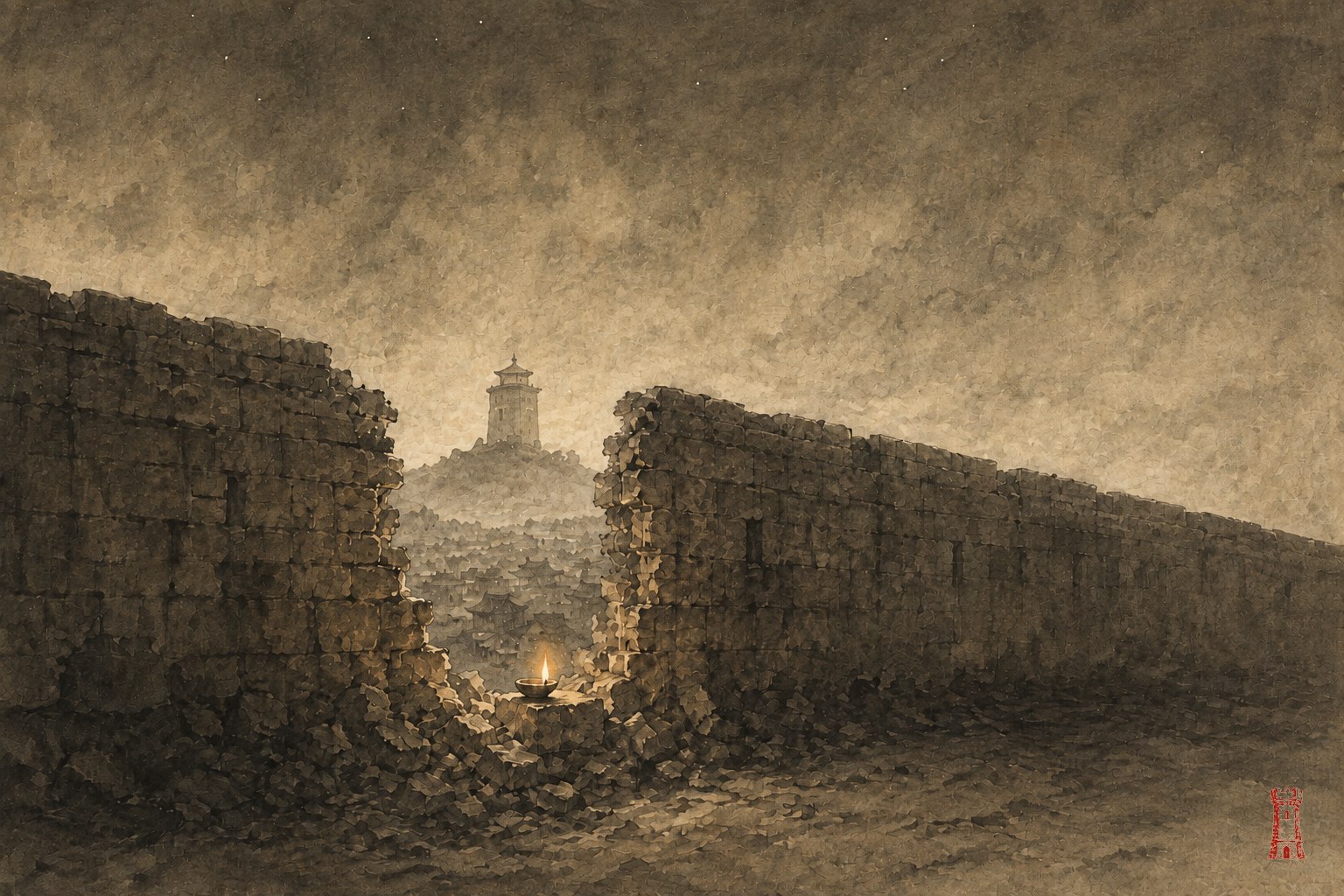
The people of the land have used oppression, and exercised robbery, and have vexed the poor and needy: yea, they have oppressed the stranger wrongfully. And I sought for a man among them, that should make up the hedge, and stand in the gap before me for the land, that I should not destroy it . . . — Ezekiel 22:29-30
A Moment to Quiet the Soul
When did you last feel quiet, truly quiet? No screens. No text chains. No emails, notifications, appointments, pressing needs, emergencies — tyrannies of the urgent? When did you last sit alone for more than a moment, only stillness — listening, watching, ready to hear? When last did you feel truly at peace? Shalom. When last did you seekingly (not passively) wait on God? Darash. Bakash. Shachar.
If you cannot easily answer these questions, this article is for you.
When did you last feel content, truly content? Nothing missing. Nothing broken. No anxiety, loneliness, bitterness, resentment, driving needs and desires — tormenting thoughts? When did you last experience joy, irrespective of circumstances — without apathy, envy, or boredom? When last did neither acedia, lust, nor greed have any hook in you? When last did you stand blameless in God’s presence?
This article is for you.
The Vacancy and the Calling
For just a moment your house is swept clean. You discern something faint filling your soul, your spirit — like a flickering lamp. The Covering, His Presence! The most recent battle is over, the latest sin confessed. Forgiveness, cleansing your heart again, and again you know you are His child. You are loved. He hasn’t left you. He never did. In this precious moment, all the high places are torn down, your idols broken. The Strongman who regularly has his way with you has been bound. You are a captive set free again. Memory stirs — you have been here before. You dread this moment passing again — when again you are pulled into slavery, when again your idle curiosities and desires get the best of you, when again you allow distractions to take you from the Presence.
But not this time. This time, you will wait to be filled — whatever the cost, however long it takes. The breaking has done its work. You no longer maintain agreements with lies. You no longer tell yourself and others wrong stories about the Father. You no longer automatically do what seems right in your own eyes. You no longer know what to do at all! Except to wait for instruction — a warhorse prepared for battle, strength restrained under the authority of the Master. You recognize the Seven, stronger than their predecessor, but refuse them entry. Only the Savior’s voice is permitted — that still, small rhema whisper.
You know it is His voice because it agrees fully with Scripture. It is much different from the lying voice of the python, the Nachash (that old dragon). His voice bids you to take His yoke and learn from Him. He is gentle and humble of heart. He offers rest but calls you to take a small step of faith. And when you step from safety into those places you could never take yourself, it is not to tempt the Lord your God. It is the obedient response to His gentle calling: LORD, if it is really You, command me to come to You on the water. And He says, “Come!”
If He doesn’t call, you don’t jump. Until He calls, you wait.
Years ago I sat alone in my house, meditating on God’s Word, practicing being still in His presence — prepared to take as long as was necessary until I heard from the Almighty Creator of Heaven and Earth. And slowly my thoughts wandered toward the questions underneath everything, and my heart went from heavy to hot, until in Jobish temerity I opened a cross-examination of the Eternal Father.
Why, God? What is the point? Every day I begin by seeking You. Every day I start strong. Every day I stumble and come short of Your glory; every day I pick myself back up, repent, and You forgive — immediately, kindly, without one word of condemnation. And before I know it: rinse, wash, repeat. It is exhausting. You know I will never be perfect here. You also know I am never going to quit seeking You — where can I go that You are not already there? I cannot escape You, and I do not want to. So why this, day after day? Why am I still here? It is pointless!
I went on like that for who knows how long — circular logic, frustration, a little barking dog in the presence of the One who holds All in the palm of His hand — until, somewhere in the middle of it, the still, small voice of Abba began to answer. Soft, but certainly not weak. The strength of it silenced every questioning thought, and I sat in awe and listened:
Michael, my son, I know you are weak and imperfect. I know you will continue to fall, continue to ask my forgiveness, continue to struggle as you walk my path and seek me all the days of your life. But my precious child, I made you with purpose, and your life is not pointless.
My angels were created to worship at my throne — and some failed in the very thing they were made to be. Every time you choose to go against your fleshly nature and follow me instead, you do what those fallen ones would not. You testify that there is none like me. You testify of me in the congregation of Heaven, and all creation watches in awe as — each time you fall — you freely choose to get up, repent, and follow after me again. O, my son, there is such purpose in your life, beyond what you can yet imagine. When you fall, confess quickly, and do not wallow in self-condemnation. Take my yoke upon you, and learn of me, and find rest for your soul.
I have never recovered from that afternoon: still in my 20’s, before the successes and failures, before the partnerships and betrayals, before the deaths and births, before the long years in the wilderness and in the pit, feeling lost and abandoned, forgotten and discarded. Before I could possibly understand what it truly means to be a witness. Yes, I have never recovered from that moment, and I hope I never do. The waiting is never wasted; and the smallest obedience of the most ordinary believer, it turns out, is testimony before the highest court there is.
In the years that followed I began to connect the dots of what God was up to — and it wasn’t the first time He was about this business.
The word of the LORD was precious in those days; there was no open vision . . . The official priesthood had become rotten. Eli’s physical (and spiritual) eyes had grown dim. His sons were helping themselves to the offerings and the women, God’s ministers brazenly engaged in theft and fornication — and we think it’s bad today! [Eccl. 1:9]
And in that fallen and rebellious house, a boy lay in the dark, ere the lamp of God went out in the temple of the LORD, where the ark of God was — lay still enough, long enough, to hear his own name called, and to answer, Speak; for thy servant heareth (1 Samuel 3:1–10). Everything Samuel became — the judge who led a nation, the man who repaired the altars and anointed kings, the restorer of an office his “elder brother” guardians had disgraced — began drawing near to God and listening. Rebuilding always begins with listening. [see, e.g., Neh. 1:4; Isa. 58:11-12; Haggai 1:8 and ch. 2] There is no other door. To act on your own initiative, on what you know is right, is to forsake the only Tree of Life there is — God’s speaking voice, His rhema Word — and to embrace the deception of self-knowledge and the ability to self-determine what is right and wrong.
God starts with a vacancy — an emptying and breaking of self, breaking of self-reliance and self-assurance, and all forms of “self” — and then filling that vacancy for the calling with His presence. He, His presence, His Word, His call is the only thing worth anything. And His calling to the lawyer and non-lawyer alike is primarily one of priesthood: one who stands between the authority and those he represents, who carries the names of others into the Holy of Holies, who pleads and offers sacrifices on their behalf.
And I sought for a man among them, that should make up the hedge, and stand in the gap before me for the land, that I should not destroy it: but I found none. (Ezekiel 22:30) Not: none were qualified. Not: the position was eliminated. None stood. Heaven issued a call that went unanswered, and a city fell for want of one applicant to the vacant office.
Whatever else comes next, hold that in your mind — in your quiet time, pull on that thread. Scripture talks about those who answer the call, those who usurp and seize that to which they have not been called, and those who refuse the call altogether. The gap, the vacancy, in the priestly calling is not a figure of speech. It is a posted position, from the throne room, imprinted in our DNA — long before the Fall, when Adam and Eve still walked with God in the cool of the day. The posting has never been taken down [Isa. 61:6; 1 Peter 2:9] — it remains open to us to respond. (when, where, and as He calls) And one day, all will be ultimately restored. [Rev. 1:6, 5:10] So why not offer ourselves, unto God, in answer to this call, while yet His breath and blood still flow through our earthly bodies?
No Inheritance in the Land
Before the priestly office can be described, one thing must be settled about the man who would hold it. For me, Watchman Nee settles it in a small, intense book (that I have read over and over) called Love Not the World.
John’s command — Love not the world, neither the things that are in the world (1 John 2:15) — is not a contradiction of John 3:16, because John is not using the word the way we do. Kosmos is not the planet, and it is not people. It is an order, an arrangement: a system of getting and holding — of seeing, desiring, and taking (because you can). It is the industry of position, leverage, and self-provision that has been running this world system ever since Cain, a fugitive from God’s Presence, went out and built the first city. (naming it for his son) The post-garden city — civilization east of Eden — began as the fugitive’s project, and it culminates in Babylon, Egypt, Rome, and even rebellious Jerusalem. It is the spirit of the world, the opposite of heaven. And this world system has been to trial, judged, and found wanting: Now is the judgment of this world: now shall the prince of this world be cast out (John 12:31). At the cross the verdict was entered. The system is not awaiting judgment. It is operating under one.
And now, one of the strangest devises in all of Scripture. Every tribe in Israel received an inheritance in the land — acreage, boundary stones, something to hold and defend. But the priests, the Tribe of Levi, received none. Thou shalt have no inheritance in their land, neither shalt thou have any part among them: I am thy part and thine inheritance (Numbers 18:20). The men stationed nearest the Presence were the men who owned nothing in the system. And any lawyer can tell you why. A man cannot represent a cause he holds a stake in; he is conflicted out. We still open every new file the same way, with a conflicts check before anyone considers the merits. Of course, God understood, before there was any land to divide, that His design for the priesthood required a setting apart — they had to be different, in the world of their brothers but not of it. The priests could stand in every gap in Israel precisely because they held no ground on either side of any of them. The priest’s portion was not in the land at all. I am thy part (says God) — the priest’s inheritance was the Presence of God Himself, the only thing worth anything. (easier written than lived, sometimes)
Hopefully, if you’ve been with me through this entire journey, as we come to its conclusion — now, you should see that the order of this series stops being a sequence (of what happens to you) and becomes an argument (of what must be done: the active voice replacing the passive). Yes, the jar must be broken. The high places must come down. The strongman must be bound. The house must be filled. But none of this, by your own power or might; it is only by the Spirit of Almighty God [Zech. 4:6]. He breaks the jar, tears down the high places, binds the strongman, and fills the house. You cannot save yourself — you cannot prepare yourself — you cannot call yourself — and you cannot sit in the office of priest by anything you do in and of yourself. God must be the One to do all of these things. He performs the action upon you, the passive vessel, who has now been fitted to His purpose.
Before the office of priest can ever be recovered, the World, your Flesh, and the Devil must all come off and out of you — because the office cannot be held by a man in whom any anti-Christ system still has its hooks. The prince of this world cometh, Jesus said on the last night, and hath nothing in me (John 14:30). Nothing. No thing. No evidence, no facts supporting his accusations, no cause of action to bring, no conflict to raise. No hook. No claim. This is the new creation, and it is restored vocation.
And here I must stop, lest you think I purport to write all of this from above the indictment. I do not. I write this soberly because I live on the razor’s edge between Christlikeness and violence, between meekness and arrogance, between receiving (from God) and grasping, seizing (what I desire). When the prince of this world comes to me, he does not always leave empty-handed. He still finds hooks and perches and a door willing to be opened. Verdicts I have needed for my own name more than for my client’s. Fees I have called provision when what I wanted was position. A reputation I have kept carefully manicured — and if I am honest before the Judge about why, it was rarely for other men’s praise. It was to prove to myself, one more time, that I am enough. I am a man, a provider, a contributor — a net addition, and not a drain, someone who has earned (not been born into) his sense of entitlement. As I confessed to a friend not long ago, I am a man who has learned how to turn stones into bread — who got good at it, fed a lot of people with it, and called it the work of God.
(O my God, continue to have mercy on me, a sinner.)
Please hear this carefully: the recovery of the office is not a promotion for men and women who have arrived. I know no one in my life who has arrived. Rather, it is the slow divestiture of our holdings in the World, until the day the pull of heaven has won over the pull of the World and we have been truly saved — not just in law, but in fact.
The Office
Let me take a step back and describe my understanding of what a priest is originally. Not what our era assumes — a religious professional, a keeper of ceremonies, a chaplain to whatever the powers have already decided. I am not treading on the province of clergy, of a calling within organized religion. I want to go back to the ancient paths and an original understanding outside of modern religious contexts — the original call of Humanity, before the Fall, and the ultimate return that Revelation promises. Scripture defines the office of priest by its functions.
A priest takes a stand.
The tribe of Levi was set apart to stand before the LORD to minister unto him, and to bless in his name (Deuteronomy 10:8).
Standing is the office’s first act and its whole posture — and standing (as every lawyer knows) is a term of art. It is the first question any court asks: does this man have the right to appear and be heard in this matter?
In God’s design a priest’s standing was conferred, never seized — by blood, by anointing, and by call. And so is ours: sons and daughters by adoption — purchased by His blood — heirs by covenant, seated with Christ and therefore able to stand. There is a reason petitions open with standing recitals.
— Ask where you have been called to stand.
A priest bears witness and represents the cases and causes of others.
Over his heart the high priest wore the breastplate of judgment: And Aaron shall bear the names of the children of Israel in the breastplate of judgment upon his heart, when he goeth in unto the holy place, for a memorial before the LORD continually (Exodus 28:29).
Judgment, worn as a garment — and the garment full of names. Twelve stones, twelve engraved names, carried on the chest into the Presence every time the priest went in.
The office holds the names and causes of others, not his own petty grievances and self-centered desires (I probably could have said that a little more nicely, but I need to be ruthless with my own idols and high places, so please excuse me). It has taken me years to notice which of the two I was actually wearing.
— Ask what you carry over your heart into your mornings, and for whom.
A priest runs into (not flees from) the plague, the brokenness, the chaos.
When wrath broke out in the camp, Moses did not convene a committee. Take a censer... and go quickly unto the congregation. And Aaron... ran into the midst of the congregation... And he stood between the dead and the living; and the plague was stayed (Numbers 16:46–48).
Mark the arsenal Aaron used: fire and perfume. He charged a plague armed with incense, a symbol of prayer offered to the Ancient of Days — a weapon of peace if ever there was one.
And mark the direction: into. Priesthood moves toward the thing everyone else is fleeing. Whatever the office is, it is the opposite of acedia, looking away, being distracted from the Presence.
Yet mark this also: Aaron ran because he was sent. When word reached Jesus that Lazarus — he whom thou lovest — lay sick, He abode two days still in the same place where he was (John 11:6), because the Father had not yet said go. Obedience to the Voice of God is what matters. The same obedience runs, and the same obedience waits. As Charles Hummel warned, the need is not the call; the call comes from the God who knows our frame. The priest’s pace is set at the altar, not by the emergency.
— Ask whether you are running sent, or just running.
A priest pleads.
The first recorded oral argument in Scripture is Abraham standing before the LORD over Sodom, arguing the number down from fifty righteous to ten, pressing the bench with the advocate’s oldest question: Shall not the Judge of all the earth do right? (Genesis 18:25).
Moses filed a three-point brief on Sinai and obtained a stay of execution for the entire nation. And Job, with no one to appear for him, named the whole ache of the unrepresented: Neither is there any daysman betwixt us, that might lay his hand upon us both (Job 9:33). A daysman — a go-between, with standing to touch both parties. The longing for an advocate is as old as suffering.
— Ask for what and for whom you plead.
A priest keeps the law with peace in his mouth.
God’s own review of the faithful priest reads like this: The law of truth was in his mouth, and iniquity was not found in his lips: he walked with me in peace and equity, and did turn many away from iniquity. For the priest’s lips should keep knowledge, and they should seek the law at his mouth (Malachi 2:6–7).
A true priest speaks rightly — of God, and of men. Law, truth, peace, equity, in one mouth, in one vocation. (There is a whole jurisprudence in that verse.)
— Ask whether God’s Word is coming out of your mouth.
A priest judges the hard cases.
When a matter arose too hard for thee in judgment... matters of controversy within thy gates, Israel carried it up unto the priests (Deuteronomy 17:8–9). The priests were the nation’s appellate bench; by their word, Deuteronomy says elsewhere, shall every controversy and every stroke be tried. [Deut. 21:5]
— Ask what hard cases keep being carried to your gates.
A priest blesses.
On this wise ye shall bless the children of Israel — and the form of blessing is startling: they shall put my name upon the children of Israel; and I will bless them (Numbers 6:23, 27). The priest’s function is to put the Name of God on people.
— Ask who last left your presence blessed.
Bar Admittance
The office of priest requires admissions qualifications that do not always come naturally, especially to lawyers. The legal industry emphasizes tangible, measurable skills that translate into efficiency and profitability. Qualities like intellectual prowess, brilliance, pedigree, resume, reputation, portable book of business — all the things we have been trained to measure and, if we are not careful, to admire too much. But Scripture does not qualify the priest as the World does.
Who can have compassion on the ignorant, and on them that are out of the way; for that he himself also is compassed with infirmity (Hebrews 5:2).
When you look at the life of Jesus, our Great High Priest, His is marked by something unknown to the gods of mythology, something impossible to contrive if you were writing fiction — compassion. Compassion, out of shared weakness and out of true love. [Matt. 9:36, 14:14; Mark 1:40-41, 6:34; Luke 7:13-15; Heb. 2:17, 4:15, 5:2]
In all things it behoved him to be made like unto his brethren, that he might be a merciful and faithful high priest (Hebrews 2:17).
Contempt, on the other hand, disqualifies. Every attorney knows the slow decay towards contempt — the seat this profession keeps pulled out for each of us, every hour of the working day, welcoming us to sit. And many of us have sat in it. When we read an opponent’s motion, lip curling, composing the humiliation before finishing the analysis. Casting judgment on the fool who signed the contract (after all, it’s just business). Even looking for — or manufacturing — ways the other side might be held in contempt by the Court. (and we will get our fees!) Where Ephesians traces the ascent — seated in Christ before we learn to walk, walking by faith (not by sight) before we can ever take a stand — the first Psalm charts the descent: walking in bad (ungodly, worldly) counsel, standing in the way of sinners, and finally sitting — settled in — in the seat of the scornful. Anytime I have lowered myself into that seat, I have traded down, because I was already seated in heavenly places in Christ Jesus. Contempt caused the inversion.
No lawyer — and especially no Christian lawyer — can occupy both seats. When the Pharisees looked at the multitude and rendered their contemptuous judgment — this people who knoweth not the law are cursed (John 7:49) — the true High Priest looked at the same flock and was moved with compassion on them, because they fainted, and were scattered abroad, as sheep having no shepherd (Matthew 9:36). Same facts. Opposite holdings. If, as lawyers, we are to see our high calling as serving as God’s priests, then we must embrace compassion over contempt, or we will be barred from eligibility.
Now read the list back as the job description of a lawyer: standing, bearing another’s cause over your heart, running toward the crisis and chaos, pleading, keeping the law with your words and being sought at your door for it (all with the compassion that comes from the true love of Christ). Hard cases and controversies within the city gates . . . what a high calling! A friend of mine, a pastor, said to me not long ago (almost in passing, the way the truest things get said) that what attorneys do every day, representing people before powers they cannot face alone, is priestly work. Then he moved on to the next thing, and I have not been able to escape his observation. He was not flattering the legal profession; he was reading the position description.
The Lamp Has Not Gone Out
Read the position description back one more time and notice what Scripture records about the men who received it. There may be more, but I immediately think of three answers to God’s call regarding priestly service.
A man can seize it. This was Saul — the Philistines massing, the people scattering, the prophet Samuel late — I forced myself, he said, and offered the sacrifice that was never his to offer. [1 Sam. 13:8–14] The tyrannies of the urgent screamed, and he obeyed them. He regarded the sentiments of people more than fidelity to God, and that cost him a kingdom. [1 Sam. 15:24] Or, a man can refuse it. That is the whole indictment of Ezekiel 22 — the wall breached, the breach standing open, every man in Jerusalem having found other work, and God’s answer? I found none. Or a man can answer it. And the answer on record — the one that restored an office that his guardians had disgraced — was no plan, pledge, or resume. It was a boy lying still in a dark room: Speak; for thy servant heareth.
I have experienced all of these answers, in myself or in others, sometimes all in the same week. But I don’t want to seize, and I don’t want to ignore. I want to respond in quick obedience to God’s call — it is a high calling, one I cannot fulfill on my own, but I believe, I know, that I can do all things through Christ Jesus who strengthens me.
When God’s call comes, I want to be found listening and ready to say, “Yes, Sir.”
What I have left to write on this topic is too large for a closing paragraph and deserves better than a summary. Whose office this is — that answer deserves discussion, because it is the most important section of this entire docket. I must talk about the Advocate who holds the office in a Court where we are admitted not by merit but by blood. And I must describe the work, what it looks like day in and day out — there is a process and a form to follow that many lawyers, like you, have been following for years without knowing. And there is more to be said — about the priest’s blessing — before this series finds its conclusion.
I am reminded: the word of the LORD was rare in Eli’s day too. The official religion and the character of those called to service were rotten, the leadership had become compromised, the vision of fathers had grown dim — but the lamp of God had not yet gone out. It has not gone out in our practice of law in this day. The posting is still up: will someone stand in the gap? And all the congregation of Heaven still watches what an ordinary believer will do with this calling. The room is as quiet as you will let it be.
For now, lie down near the Ark, where the Presence resides. That is holy ground.
Speak, LORD; for thy servant heareth.
Turris fortis mihi Deus.
— — —
Michael C. Kelley is a Florida attorney and shareholder at Lawson Huck Gonzalez, PLLC. He writes at Turris Fortis on faith, justice, and the practice of law as peacemaking — not the kind that confuses peace with avoidance, but the kind that contends for it with the weapons God supplies. Turris fortis mihi Deus — Prov. 18:10.
This is the seventh and final essay in a continuing series, best read in order — Start Here has the full map. It begins with Where Chaos Meets Holy Ground and continues through The Weapons of Peace, They Have Not Spoken Rightly of Me, Breaking the Jar, Tearing Down the High Places, and Bind the Strongman. It arrives in three parts; Part 2 — The Record — the facts, the standard of review, and the governing law — is published; Part 3 — The Office Recovered: the closing argument, conclusion, and prayer for relief — is published. The series is complete.