I am not suggesting that you jump off a (financial) cliff — hoping His angels will catch you — and try to call it faithfulness when that is not what He has called you to do. Rather, for the willingness to let Him ask for the whole thing . . . And then to find out [ ] what He does with a thing that has been fully given.
I finished The Good Steward (Part 1) and immediately began to think about what needed to come next. This word needs to be redemptive and not just the conviction of a deadly sin. Yes, I think stewardship has become idolatry and Mammon in our modern use of it and that we have become blind to the serpent behind it, but God wants to restore the proper understanding for what stewardship is and why we are called to it. Here, I will try to get closer to God’s intention behind the word.
I love the idea that there is a path, a road, a Way that leads to eternal life. I see God’s creation most easily sometimes in metaphor and simile, and the more complex concepts in parable and allegory. But the Way of Life — the narrow path, often hidden and difficult to see, requiring the lamp of the Holy Spirit for each step I take — being an actual road that I walk on, and that there are ditches on each side of that road (not to mention the numerous counterfeit paths that take you away from the real one to “dead ends”), has become one of the easiest metaphors to reach for when thinking about the obedience God is calling me to. And when I find myself responding to Him as Jonah or the Rich Young Ruler: scared of being called to sell all, give it away, and follow Jesus — for real, not just the way I give a big tip to a good server or donate something meaningful to a deserving charity, but to really give the whole of myself to Him and it scares me; I find that there are two common reactions, two ditches on either side of the road, that conviction produces in me.
The first is for me to abandon my post, sell everything and run — I don’t know where, somewhere! And the second is for me to decide God asks too much — I go numb and walk away disappointed because I have accumulated many good things that I thought God would want to use.
Cast Thyself Down
Then the devil took Him into the holy city [Jerusalem] and placed Him on the pinnacle of the temple. And he said [mockingly] to Him, “If You are the Son of God, throw Yourself down; for it is written, ‘He will command His angels concerning You [to serve, care for, protect and watch over You]’; and ‘They will lift You up on their hands, so that You will not strike Your foot against a stone.’” [Psalm 91:11, 12]
—Matt. 4:5-7
We always look for a formula, something we can follow to guarantee an outcome. Sometimes we don’t even care what the outcome is, only that we can predict and know it so that we can plan for and around it. We like to hedge our bets — some might call that being a good steward of what God has given.
When the conviction of the Holy Spirit reveals a deep-seated rebellion against God in the way we have carefully curated our own life — when God looks at us and says, “One thing you lack” — often, we don’t even wait to hear what He says next. A sudden urge wells up within to abandon everything — If I’ve been wrong, I will fix it! — and the temptation to simply launch ourselves into some ministry or work or calling that God has not issued becomes almost overwhelming. At times, for me, it has become almost tormenting. (I wonder if that’s what the voice of God sounds like?)
Such a response is often still a temptation towards self-rule, a ditch off the Way of life. It looks clean and virtuous and pious and saintly. It is often the voice of a serpent in disguise. “Hath God not said…” It offers to trade consumption with renunciation, and we applaud the well-meaning man who gave all to follow … Who, exactly? Did we wait for what God said, or just launch ourselves into our own calling?
Satan quotes Psalm 91 to try to convince Jesus to do something dramatic for God, for the ministry. But Jesus’s response: “On the other hand, it is written and forever remains written, ‘You shall not test the LORD your God.’” [Deut. 6:16]; reminds us to listen and respond to God’s voice, His call, and not just launch into what seems godly. When Peter launches himself out of the boat, the physical action looks very much like what Satan tempted Jesus to do from the temple. The difference is that Peter was responding to a call from the LORD, while Satan’s temptation was to create spectacle and to test whether God would show up.
In America, the Enemy tries to lure you with consumerism, first. If that doesn’t work — if the shelves and collections finally stop satisfying our desire to accumulate and save (for some rainy day?) — he tries for asceticism: another works-based salvation that looks like self-denial and holiness. We think we are taking up our cross. Maybe we think to become a monk or missionary (to someplace God has not called). Sell it all. Go somewhere hard (and be seen going). Between a prosperity gospel — God must be happy with me—look at how He’s blessed me! — and self-chosen martyrdom, the Serpent does not much care which ditch you choose, so long as you chose it yourself.
Hear me, friends. If God has called you to the life of an ascetic, that is one thing and I certainly do not call it wrong. Sometimes I wish that God had called me to such a (seemingly) simple life. But to choose it for yourself just because you are convicted of your sin, or just because you want to be seen as the godly man following his Savior, is hubris. It is false humility, which is pride, and the opposite side of the same works-based salvation coin that it ran away from. In Colossians 2, Paul called this sort of thing a false or mock humility: These practices have the appearance [that popularly passes as that] of wisdom in self-made religion and mock humility and severe treatment of the body (asceticism), but are of no value against sinful indulgence [because they do not honor God]. (Col. 2:23).
And the giveaway is always the same: we are the ones who decide between good and bad. We have made ourselves the ultimate arbiter of when the rules should be kept and when they should be set aside, and we have made ourselves the arbiter of our penance, too. We decide what we did wrong, what it will cost, and what we will pay before we allow God to say even a word. This is not true repentance — this feeling bad and electing to do something severe as punishment or self-selected atonement. It is settling the case of our own fallenness out of court so that we never have to appear before the Judge. No change of heart and throwing ourselves at His mercy.
Reject this temptation of resorting to spectacle, running away and casting yourself off whatever high place you were falling from anyway — testing God to see if He will catch you when you can no longer stand the pressure of His gaze. Allow Him to test you, your motivations and your desires — allow Him to purge the idolatry from your heart. Let the fire of His holiness burn the chaff and dross and deep infected wounds. Respond only to His call, and do not heed the voice of any other.
I Knew Thee That Thou Art an Hard Man
The one who had received one talent also came forward, saying, “Master, I knew you to be a hard and demanding man, reaping where you did not sow and gathering where you did not scatter seed. So I was afraid [to lose the talent], and I went and hid your talent in the ground. See, you have what is your own.”
— Matt. 25:24-26
We are still telling the wrong stories about God. The man who quits trying, walks away dejected, the Ex-vangelical — who tried a caricature of God and found his ideal wanting — and the other who runs where he was not called into something that looks like godly service — but was born of the flesh rather than the Spirit — both share the same theology: God is hard. Following Him, serving Him, obeying Him, knowing Him requires work and time. And I don’t get to do what I want. So the one buries his talent and the other burns it. But neither of them asked Him.
We need to ask ourselves: “What are we doing this for? Who is it for?” and “What does He actually require?” Which means we need to know Him and what He has said. But the stories we tell today were handed to us by well-meaning men who still operated from a scarcity, fear-based mentality that — at its worst — denies the character and sovereignty of God. We need to consider whether we aren’t operating under the same false spirit that brought true wrath against Ananias and Sapphira. Because if we truly believe that God is as He is revealed through His Word and the testimony of His Son, it wouldn’t require our choosing, our deciding, our holding back, our manipulation and involvement to figure Him out and to set things right. We would just rest in Him.
“Come to Me, all who are weary and heavily burdened — by religious rituals that provide no shalom — and I will give you true rest, refreshing your souls with salvation [from your striving]. Take My yoke upon you and learn from Me, for I am gentle and humble in heart, and you will find rest for your souls. For My yoke is easy [not hard] to bear and My burden is light.” This is who God is. He is the Father who comes running to you when you finally get up from your muck and mire, when you finally put down your hammer and nails, when you finally cry, “I believe! Help Thou, my unbelief!” and fall into His arms. But somewhere in our flesh and the common sense of this world, even though we preach against works-based salvation, we still want to earn it.
I have struggled with the idea of the wrath of God. Even today in a weekly Bible study with salty old warriors who have been swinging their Sword of the Spirit for so long their hands are stuck to it, we argued about God’s wrath — Is it aimed at the sinner, or the sin? Is it really that He created a world of beings that He expects to worship Him — and if they don’t! — boy, His wrath is kindled (and hell is hot, brother) . . .??
Or, does He know something about every created being with a free will that we, in our fragility and limited understanding and temporal perspectives, fail to appreciate: that we will always worship something or someone — and that if we were handed eternity prematurely, we would be lost to our own insatiable desires and rebellion, like the Fallen, becoming totally irredeemable? I have come to think God’s wrath is kindled against the Lie, and against those who are given over to it. Sin creates separation from God, and that separation is death — but it seems there is a world of difference between the one who sins accidentally, unknowingly, or even habitually (but truly repents), and the one who sins intentionally to God’s face.
Of course, salvation is still possible and the best news the Gospel offers is that through Jesus all can be rescued from an eternity lost without God. But something about the sin of the Pharisees, the upside-down theology of Job’s friends, the abuses of the sons of Eli and Aaron’s sons offering strange fire, Ananias and Sapphira thinking they could trick the Holy Spirit — something about that level of lying to God (and lying to others about God) always seems to evoke His wrath. In Luke 15, the one left standing outside the feast is the elder brother — the good steward of the household. The Father goes out to him, too — redemption offered. In the Gospels, the story ends without us knowing what happens and whether the elder receives his Father’s love.
The Fast That I Have Chosen
“‘Why have we fasted,’ they say, ‘and You do not see it?’ . . . [because] on the day of your fast — when you should be grieving for your sins — you find something you desire to do, and you force your hired servants to work instead of stopping all work, as the law teaches. [Lev. 16:29] . . . Do you call this a fast and a day pleasing to the LORD? Rather, is this not the fast which I choose, to undo the bonds of wickedness, to tear to pieces the ropes of the yoke, to let the oppressed go free and break apart every enslaving yoke . . . to divide your bread with the hungry and bring the homeless poor into the house; when you see the naked, that you cover him, and not to hide yourself from your own flesh and blood?”
— Isa. 58:3-7
So go back to the beginning: what has God said, and what, O mortal, does He require of thee? For every one of us there will be a general answer — a guiding principle that we can locate in Scripture; and a specific answer that will not look the same for each but must be sought for through much prayer and seeking. One will be called to give her treasure away, and the other called to burn it — one to pour 17 bottles from his collection out as a drink offering unto the LORD, and the other to treat the wounds of the broken. There is no formula to share. No secret to impart. Only restless wrestling in the early morning hours of the man or woman who would know God and hear His voice. (Ps. 27:8, 63:1; Lam. 3:23; Mark 1:35).
But the general answer is not hidden, and Isaiah gives it to the good religious people who were fasting with great effort and attention. They had a version of the law and they kept it, but it was not God’s Law, not His commandments. Where did we get the idea that Israel or the Pharisees were so good at keeping God’s Law? They were not. They kept their version of it, mostly filled with the traditions of men. They kept the outward show but not what God had actually commanded and had written on their hearts, and they used loopholes to subvert His Law. They were lawbreakers, all the while professing to be its keepers. That was the issue Jesus had with them: not that they were the best people who had fallen into self-righteousness and being too good. But because they were openly flouting God’s Law and lying about it. In a divine plot twist that only God could have foreseen, their arrest, trial, and execution of Jesus was God putting them on trial for being the lawbreakers they actually were — every step they took to silence the One who exposed them was itself a violation of God’s Law.
And it seems to me that the modern church, and the modern Christian lawyer, are in danger of being/becoming the exact same: lawless in our dealings with one another; suing each other; taking from others — taking capital, businesses, relationships, talent and employees, creativity, innovation, work and work product, ideas and inspiration. Any religion that teaches men to trick other men, to use them for selfish gain and call it “vocation,” to take advantage and call it “excellence,” to climb the ladder past, over, and through everyone and call it a “Protestant Work Ethic” or “godly ambition,” to withhold good when it is in your power to do it and call it “stewardship,” to permit collateral damage and call it “just business” — all of that is anti-Christ. It is from the devil — he was a liar from the beginning, and his children do his works. And it is most certainly not limited to “those people over there,” the liberals or the fascists, the communists or capitalists, or whichever label we reach for this year. It is pervasive throughout humanity, and it is exactly what the irreligious person — whom God loves and came to rescue — rejects about the God His people claim to represent but do not show His love in their dealings.
I think the root of it is how we hold God’s commandments. We treat them like a social contract, rules we have all agreed to live by in polite society, or rules of a game that we have all agreed to play fairly — rules set by someone outside us, most of which we agree with, a few perhaps a little outdated, but all of them breakable for really good reason: ending a sentence in a preposition just because; fouling to stop the winning shot or pass interference to prevent the touchdown; speeding to get to the meeting on time; taking the business deduction for the personal expense; padding your hours at the end of the month so that it looks like you were crushing it; the 57.105 that is not justified but will result in more fees; omitting that one case that destroys your entire argument. And we make ourselves the arbiter of when and where the rules apply. This is how we live. That is how we justify ourselves. And it is how we have reduced God to someone who set the rules and lets us call the fouls. But His commandments were not meant to be a rulebook that we measure ourselves by. They are guidelines: for how to live — in harmony with Him and with each other; designed to create a heart posture — a daily dependence on God, for everything; teaching us how to allow Him to live in and through us — For in Him we live and move and have our being (Acts 17:28); revealing His true fast and what that posture does with a payroll, a contract, a competitor, and a single-mother client who cannot pay her legal bill.
Inside a law practice, the fast He has chosen looks like this. The yoke you must break might be the one you built: the associate billed to exhaustion so the margin can be held, the staff carrying your deadlines on their own time, the junior partners squeezed out to juice this year’s bonus. The bread you divide is the hour that will not be billed and the origination you share gratuitously. The naked you cover is the opposing party who is about to be destroyed by a technicality you could, legally, exploit and the out-of-town lawyer who didn’t read the local rules as closely as he should have. And the “hide not thyself from thine own flesh” part is perhaps the brother or sister across the aisle, the one at the other firm, the one who used to be your partner — the one you would rather sue than call.
Let me be careful not to go too far with these. I am naming sins of a trade, not the hearts of men and women within it. I can judge fruit — we are all called to judge fruit. I cannot judge the root. Judge nothing before the time, until the Lord come, who both will bring to light the hidden things of darkness, and will make manifest the counsels of the hearts. What I can say is that this conduct is sinful and this pattern is bad fruit. What I cannot know is the heart behind it — and I would never say it is beyond His mercy or beyond redemption and restoration. That is the beauty of Jesus! All can be restored in the spirit of meekness, and we should all consider ourselves, so that we not fall into the same temptation. I write all of this considering myself.
The Good Barn
I don’t think God’s quarrel with us has ever been over our having barns. Daily bread looks different when it’s for an individual versus a family of four versus a city of 9,000,000. I think we could fairly say that Joseph built the largest barns in the ancient world — seven years of reserve saved up for seven years of famine for most of the known world. The rich fool built barns too. The difference isn’t the size or what they are used for, but rather, why they are. So the 401(k), 529s, and reserve accounts I confessed in Part 1 are not automatically sin. God is not against planning and wisdom — He created the seasons with reason, He allows weather that disturbs normal cycles and patterns, He gave us examples in creation like the ants for a purpose. My criticism of our form of stewardship is not against practical reality and being prepared for the normal seasons of life. I am criticizing our why.
What I wrote in my 2022 journal entry was not exactly wrong in its picture, only in its direction: “roots and branches and shelter and fruit for others to enjoy” is a Joseph barn. A reserve that exists so that others can eat during times of personal famine is the fast that God has chosen, stored in advance, stored up for the perfect moment to show His goodness and attention. But a reserve that exists so that I can say to my own soul, “take thine ease for you have done well,” is the fool’s. It is not the barn that tells you which is which, only the why. Why is it and whose is it (ultimately)?
The Corners of the Field
Now when you reap the harvest of your land, you shall not reap to the very corners of your field, nor shall you gather the gleanings of your harvest . . . you shall leave them for the poor and for the stranger. I am the LORD your God.
— Lev. 19:9-10
I love this idea. It follows the bounty of God as seen in flowers and seed and birds and fish. The generous life. Stewardship is not just about accountability and an even balance sheet — if anything, you give out more than you receive or save. This is the creative miracle of God’s multiplication. He operates exponentially: one seed produces hundreds or thousands of seed; five loaves and two fishes feed thousands with baskets left over. “O ye of little faith!” O, me of little faith.
The corners of the field were not charity added onto the harvest after the accounting was done. The giving to the poor and the stranger was built into the harvest by God. Before we knew if it was a good harvest or not, before the first sickle went in, the provision was already determined. The owner who reaped all the way to the fence line had not been efficient. He had stolen from those God had planned for, and he had stolen from God. This is the sin of the well-meaning religious people in Isaiah’s time, Jesus’s, and ours today. Boaz understood what God had commanded. He ran his operations well enough to afford to leave the corners, and he did. His excellence and his margin were the same act — and he had more than enough left over.
In a law practice the corners look much like what I listed at the end of Part 1 as a rebuke. Here, they are simply the picture of an abundant life. The associate who needs an afternoon that will not be billed and will never be known. The client who needs to hear the truth that ends the engagement. The pro bono matter that no one will photograph, that takes three years and does not settle well. The fee forgiven for the family that cannot pay, and not deducted, and not mentioned. The hour with your children that the practice says you cannot afford. When done in obedience to the One who commands your billable hour, these are not the write-offs of a soft or ineffective lawyer. No. They are handfuls of grain and purpose of a mighty man or woman of great wealth who knows deep that “it is He that giveth power to get wealth.”
Let Thy Gifts Be to Thyself
When the finger of God wrote on Belshazzar’s wall and the king offered Daniel scarlet and a gold chain and the third place in the kingdom to read it, Daniel answered: “Let thy gifts be to thyself and give thy rewards to another; yet I will read the writing unto the king.” He read it anyway. He did not refuse the position; he refused to be bought by it.
Daniel is a picture of the restored steward in Babylon: an excellent spirit was in him; serving dutifully and promoted in every situation and place he was found. His rivals searched for an occasion against him but could find none. He was faithful, uncompromising, and embarrassingly uncalculated. He excelled in pagan Babylon to the point of bitter jealousy from those who did compromise, who were calculating and conniving and ruthlessly efficient, and yet it never became about the success or wealth for Daniel. How wonderful to have it all and not be captured by any of it! Throughout Scripture we see pictures of this sort of faithfulness — trusting God no matter the apparent cost or risk, no matter the odds or size difference; faithfulness willing to be abased and yet knowing how to abound; accepting the gold chain, crown, and position today and being stripped of it tomorrow without changing what or how you pray because the One you serve remains the constant focus in your life.
When we stop focusing on the results and the harvest and the positions of authority our hearts crave, and focus rather on daily obedience, in the gathering and the scattering, the storing and the pouring out, holding everything loosely for the glory and purpose of the One who owns it all — that is when true stewardship of God’s Presence is displayed. And these are the men and women God uses to bring healing to a lost and broken world.
Repairer of the Breach
And they that shall be of thee shall build the old waste places: thou shalt raise up the foundations of many generations; and thou shalt be called, The repairer of the breach, The restorer of paths to dwell in.
— Isa. 58:12
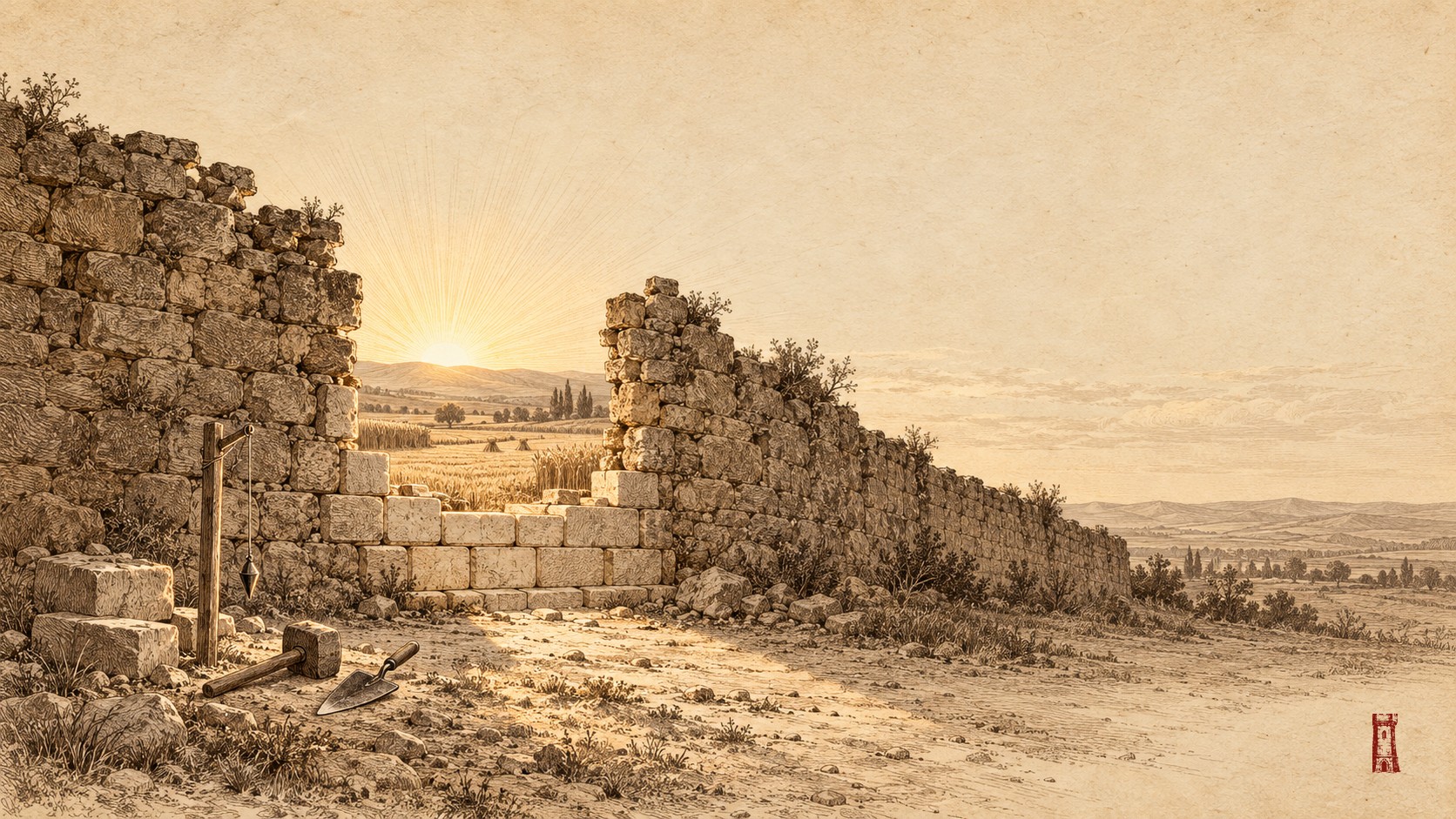
We are called to occupy the gap, the space, the place on the wall that God has assigned. I am not called to defend someone else’s wall or to advance someone else’s cause. I am called to defend the very place that God has assigned to me. Satan will try to get me to run away from that calling, to abandon it for something that looks pious and good and obedient — but that is my own idea of right and wrong. I need to clearly hear God’s voice — which is easy when discerning between the Accuser and the Comforter, between the Tormentor and the Healer. It is extremely difficult when the Python is quoting Scripture back at me, saying something that is sort of true, close to being right, but is in conflict with the Spirit of God and the full counsel of Scripture. That is when I need to be certain I know the Shepherd’s — so that I do not mistakenly obey the voice of the Imposter.
This is why God has put some of us at the tops of industries, and why He is convicting us of sin now. It is not so that we abandon what He has called us to and become powerless but so that there would be, at the tops of firms and banks and companies and ministries, people who repair — who loose the bands, break the yokes, divide the bread, and do not hide from their own flesh. Repentance, humility, generosity — this is the fast that God has called us to and is the fast that must be kept at the partners’ meeting, the courtroom, and highest places God may call us to. The world desperately needs to see that there is a right way to be Daniel in Babylon, which will never be seen if every convicted Daniel resigns his or her post.
The narrow Way is described by God Himself by its two ditches: “thine ears shall hear a word behind thee, saying, This is the way, walk ye in it, when ye turn to the right hand, and when ye turn to the left.” Not a formula. A voice with you, behind you, beside you, on the road, as you walk, at the moment you drift to the right or to the left. Everything God has given to us in His Word is about preparing us to become the chariots and temples and houses of God’s Presence — a steward of mysteries, which is simply a man or woman who has made room for Him and then stayed at the post where He called them to be.
Closing
For my collection that started this journey into stewardship some years ago, God did not tell me to pour it out as an offering. He told me to give it away. Housewarming and hosting gifts. Birthday presents. The occasional bottle opened on a porch with a few brothers, for those rare moments when words need to flow in an honest conversation and cannot quite find their way to the surface — not to excess, and not because a drink is required for confession, but because every man who has sat in that circle knows it is sometimes easier to say the true thing after one. Anyway, I am still fumbling around trying to hear His voice clearly enough to know what to do next, and maybe the next thing will look completely different from the last.
That was four years ago. I have empty collections to prove it, but more yet to yield. It turns out, however, that items from a trophy case and a display shelf, collected over a long time by someone with a very discerning palate, make the best gifts to friends, family, and strangers — the fruit of a good life, blessed by God, shared with others, poured out and given away — not wasted and no longer kept for idle admiration. In 2022, I wrote that it would be such a waste to throw it all away. He hasn’t yet asked me to do that (but He might); instead, He allowed me to let it leave my hands in the hands of others. I am pretty grateful for that blessing — to pass something of value on to someone else who will value it. But even if my treasure ends up in hands that cannot appreciate it or ends up in the dirt, may I only be faithful to respond to His voice and do with it as He pleases. It is, after all, only His anyway.
Then shall thy light break forth as the morning, and thine health shall spring forth speedily: and thy righteousness shall go before thee; the glory of the LORD shall be thy rereward.
— Isa. 58:8.
Lord, teach me to be a steward of Your Presence and this short life You have given.
Turris fortis mihi Deus.
— — —
Michael C. Kelley is a Florida attorney and shareholder at Lawson Huck Gonzalez, PLLC. He writes at Turris Fortis on faith, justice, and the practice of law as peacemaking — not the kind that confuses peace with avoidance, but the kind that contends for it with the weapons God supplies. Turris fortis mihi Deus — Prov. 18:10.
The Good Steward — Part 2 stands alongside the numbered Turris Fortis essays rather than within them. It continues The Good Steward, and it takes for granted what that essay says. The full map is at Start Here.