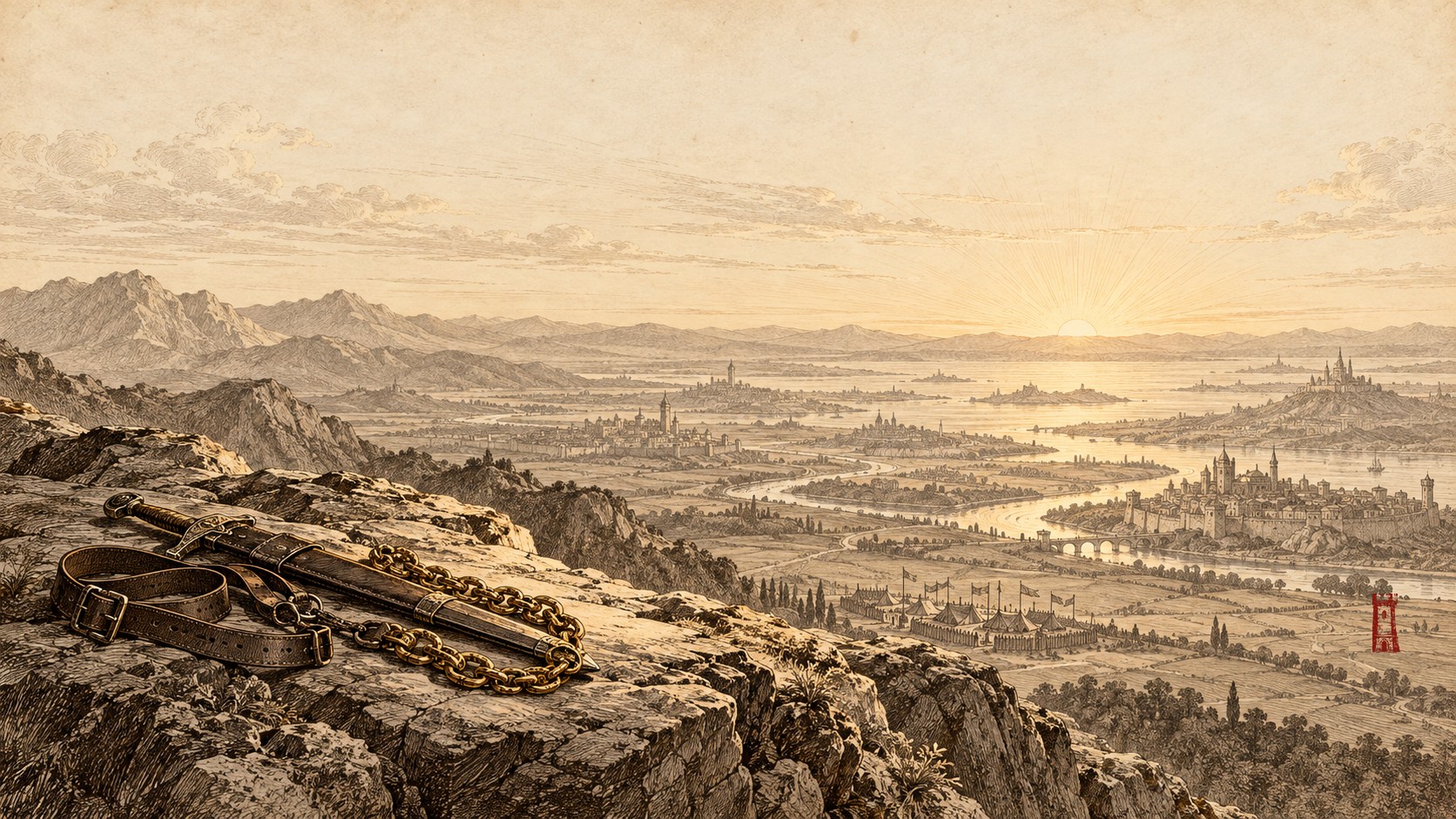
And the devil, taking him up into an high mountain, shewed unto him all the kingdoms of the world in a moment of time. And the devil said unto him, All this power will I give thee, and the glory of them: for that is delivered unto me; and to whomsoever I will I give it. If thou therefore wilt worship me, all shall be thine. And Jesus answered and said unto him, Get thee behind me, Satan: for it is written, Thou shalt worship the Lord thy God, and him only shalt thou serve.
— Luke 4:5–8
Opening — Seeing Life from the Wilderness
It’s funny. I failed to see this when I began writing about stewardship. I say “funny” because so much of the way I view life and experience on Earth is vividly through scenes from Jesus’s life — in particular, his temptation in the wilderness. Maybe I have Dostoevsky to thank for that. Seems I was writing this series from a Jesus-after-the-wilderness perspective without recognizing that until now.
The first Good Steward essay was mostly about provision — money, possessions, security and the insidious way we can say that everything belongs to God while still arranging our lives so that we never actually have to depend on Him. We want to be seen as good stewards. But often, we’ve just learned how to turn stone into bread (Matt. 4:3) — the temptation to meet a legitimate need by taking matters into our own hands, doing what seems right in the moment versus waiting on God to speak. In my life and legal practice, I have learned to turn stone into bread — for good reason, and to good effect: to feed the hungry, to share the kindness and gifts of God — but really I was just celebrating myself and my abilities.
Then the second essay (Good Steward — Part 2) moved somewhere else — to the pinnacle (Matt. 4:5-7). To presumption: “Hath God not said?” (Gen. 3:1) The temptation to choose the cliff ourselves and then ask God to prove Himself by catching us when we launch into something good, something godly even. It is possible to call something faith when God never told us to step out there in the first place.
But as I reflect upon those last two articles and what I began writing as an exposure of false stewardship, I recognize there is one more temptation left.
The mountain.
Where the kingdoms of the world can be seen in a glance. The devil shows Jesus all the kingdoms — their power, their glory — and offers everything: everything He was promised, everything prophesied (Ps. 2:8; Dan. 7:14), in exchange for one bow, one little compromise (for the greater good! the end will justify the means!) (Luke 4:6-7).
What has always fascinated me about the wilderness temptations is that none of them are invitations to become obviously wicked. They are not even invitations to doubt God, like the temptation Ha-Satan (“the adversary,” “the accuser,” “the prosecutor”) used to entrap Adam and Eve. And think about that for a moment: Satan was Heaven’s Chief Prosecutor — as corrupt an official as could be fathomed, no doubt — where it is apparently not against the Law for the adversary to use entrapment to get you to break it (another sermon for another time). He is trying to entrap Jesus as well, but not in the same rudimentary way — not the way he entraps so many of us, with sins that so easily beset.
Jesus is not being tempted to murder someone or to steal or take — to grasp — something that doesn’t belong to Him. Jesus is not even being tempted to worship some grotesque pagan image. Later in John 16, Jesus will refer to Satan as the prince or ruler of this world. There are hierarchies in Heaven that we have only begun to fathom. There is an entire legal system and order that we see only glimpses of in Job, and Psalms, and Zechariah, and Revelation. From a certain point of view, it might have even been right or expected for Jesus to give Satan certain honor and deference — much like we would to a foreign dignitary or ruler. I don’t know what might have been expected in the Courts of Heaven, but it’s fair to say that Satan’s temptations of Jesus were layered and nuanced and exceedingly cunning: Feed Yourself. Prove Yourself. Allow me to give what has already been promised to You. And he uses (or misuses) Scripture as bait. But the actual temptation, which Jesus of course sees through —
Use legitimate power, but independently from the Father.
And this is what I have been circling with these essays without quite seeing it at first. Good, godly stewardship is not about whether I keep something or give it away. It is about whether I have accepted that I am not the one in charge. This applies to money, certainly. But it applies to faith as well. And it most certainly applies to power. Maybe especially power.
Luke puts power and glory together in the same offer — “All this power will I give thee, and the glory of them” (Luke 4:6). I think that should tell us something. The hard power that makes people obey and the softer power that entices people to admire are not completely different idols. They belong to the same kingdom. One makes people fear you. The other makes them want to be you. Both can feel remarkably good. And both can — and often do — become substitutes for God and faithful presence.
The Idol That Wears Armor
Mammon is not particularly difficult to preach against. In the form it is worshipped in churches and society today it can often be difficult to see. Toxic generosity is often difficult to see because it so closely resembles the real thing. But everybody knows greed is ugly. Nobody wants to think of himself as the rich fool building bigger barns. We may find sophisticated and nuanced ways to justify our attachment to wealth — Prudence. Responsibility. Stewardship. Providing for our families — but somewhere in us we know that money, and the love of it, can easily become our idol.
Power and strength, however, are harder. Scripture actually praises strength. It praises courage, endurance, boldness, excellence, dominion, victory — being more than a conqueror (Josh. 1:9; Ps. 18:32-34; 1 Cor. 16:13; Gen. 1:28; Rom. 8:37). And God Himself is called mighty (Ps. 24:8) — Warrior (Ex. 15:3) — Fortress (Ps. 18:2) — Strong Tower (Prov. 18:10). That last one has been hanging over my own life for decades.
Turris fortis mihi Deus. God is my strong tower.
I am not saying that strength or power or courage is bad. Rather, that GOD is my strength. That distinction is harder to hold than it sounds because the counterfeit looks so much like the real thing. It sounds like what you would hear in churches and prayer meetings and fellowship gatherings. It speaks the language of courage and duty and talks about defending what is good and just and pure, protecting the weak, refusing cowardice, standing firm, rebuilding the ancient foundations, redirecting civilization, pursuing excellence, winning battles, defending fundamental rights and religious liberties, and becoming strong enough that evil is afraid. And the difficult thing is, some of those things may actually be true. That is why this idol — this python— is so dangerous. These are the predators that blend in, that remain camouflaged so well because they are just close enough to something biblical that we stop examining them. They have become part of our furniture for so long that we no longer see them.
There is also a kind of strength in us that is not itself evil. It is the fire the makes a man stand up when someone weaker is being mistreated. It is the conviction that makes you run toward a fight instead of away from it. On a board of Elders during covid this fire was ignited in several of us — we didn’t know exactly what to do or what was loving of neighbor and honoring of truth, but we knew we could not stand idly by and allow spiritual culture and fellowship to be extinguished and ultimately ruled by fear of the unknown. Courage, zeal, protectiveness, even a desire for honor can be and often are rightly ordered in the Christian. These fires can be beautiful and God-given engines of human ability. But engines can take you places.
Some trust in chariots, and some in horses: but we will remember the name of the LORD our God.
— Ps. 20:7
Something changes when strength stops being something we offer to God and becomes the thing in which we trust. This is especially true for the Christian Lawyer. The voice may sound something like — Be strong! Win. Do not let them intimidate you. Do not let them humiliate your client. Make them respect your firm. Make them honor you. Make them see. Show them. Do not be weak. God wants you to be vindicated. He wants you to prevail. He wants YOU to set things right again. — and every other iteration of these that we say or believe on behalf of ourselves, our families, our clients, our causes, our own little kingdoms. And the voice can sound, again, remarkably like courage. And sometimes it is courage. Other times it is fear wearing armor. The problem in God’s eyes is not human strength. It is strength detached from dependence upon God — the original temptation.
When Sennacherib stood outside Jerusalem with the largest army in the world, Hezekiah told his people, “With him is an arm of flesh; but with us is the LORD our God” (2 Chron. 32:8). Jeremiah curses it directly: “Cursed be the man that trusteth in man, and maketh flesh his arm, and whose heart departeth from the LORD” (Jer. 17:5). Mammon says, I will be safe because I have enough. The arm of the flesh says, I will be safe because I am strong enough. One builds barns. The other builds armies and launches into a crusade. The thing we have decided to trust in changes, but the transaction we engage in remains the same: Something created has become the object of a confidence that belongs to God alone.
Not by Might, Nor by Power
Not by might, nor by power, but by my spirit, saith the LORD.
— Zech. 4:6
There is something almost too obvious about this verse that I have been praying for years. I have prayed some form of it nearly every morning for all of my adult and adolescent life: Not by my wisdom or intellect. Not by my strength or ability. Not by manipulation or control, the wrath of man or the arm of the flesh. Not by ego or will. Not by power or might. But only by Your Spirit, Almighty God!
It is easy to miss the fact that it is being said to a man with work to do (Zech. 4:6-9; Hag. 1:1, 14). Zerubbabel is not sitting in a monastery trying to rid himself of power and ambition — he is not fasting — he is not beating himself up over his sin. He is a governor. There is work to be done. There is a temple to rebuild, opposition to face (Ezra 4:1-5), political realities to navigate, people to lead, actual stones that have to be put into actual places to rebuild the walls that provide defense from invaders. God does not tell him to stop building. He tells him the only thing that will build — and that is a very, very different thing. “Not by might, nor by power” is not a hymn to passivity or weakness. It is not permission to become timid or ineffective or unserious about the work in front of us. Zerubbabel still has to get up tomorrow morning. There is still a wall. There are still enemies watching. There are still hearings and motions and depositions and trials. There is still acrimony and bitter rivalries. There are still tools and weapons of the trade that must be wielded — the trowel in Zerubbabel’s hand is like the sword in the soldier’s hand is like the motion for sanctions in my hand. These tools and weapons are not God. And neither are the hands that hold them.
Here we come to the point. God may give you extraordinary power and strength for the assignment. Intelligence. Money. Influence. Courage. Authority. A position in the room where decisions are made. He may make you very, very good at what you do (Deut. 8:18). The mistake is not having those things — it is forgetting Whose they are. Or worse, beginning to think the assignment depends on them or on you. Thinking that you ARE the gift and then acting like it — when you were only ever supposed to be a vessel fit for His purpose, “a vessel unto honor, sanctified, and meet for the Master’s use” (2 Tim. 2:21). Sometimes, like with Gideon or David (Judg. 7:2-7; 1 Sam. 17:39, 47), this is why He must allow the army to get smaller — so that we are reminded that He is what truly matters.
The Chain and the Sword
In The Good Steward Part 2, I asked whether we could hold the gold chain the way Daniel did (Dan. 5:17, 29) — able to receive it today, willing to lose it tomorrow, and never change a thing about who we are or how we pursue God. To essentially be unchanged by any event or circumstance or power or wealth. I think authority and power require the same test. Can I hold strength without needing it? Can I use authority without becoming attached to being the one who has it? And maybe the harder question: What happens when God tells me not to use the power that I unquestionably possess? What happens when He tells me to put the sword away?
As an attorney involved in high-stakes litigation, this bothers me the most. Because law is, after all — and among other things — a power trade. There is nothing inherently wrong with that. A lawyer is given lawful tools and weapons of our trade for good reason. We do create leverage. We use discovery. We build records. We file motions. We cross-examine witnesses. We force issues to decision. Sometimes love of neighbor requires ferocious advocacy — to stand up on behalf of those too weak to stand for themselves. Firmness is not sin. Strength is not sin — in fact, only the strong can be truly virtuous. Exposing corruption and lies is certainly not sin. Refusing to use available strength because we want to feel holy and righteous, because we want to be tolerant and to coexist in some form of peace and harmony, can easily become its own vanity and hubris. But I have also had occasions where I knew exactly what motion I could file to ruin someone’s entire case, or life — the very real pressure points that discovery and sanctions motions provide. The allegation that would create maximum difficulty. Exactly how much leverage I had and how to use it to greatest effect. Many times (at least in my own rationalizing), the very existence of a weapon creates its own argument for my use of it. And using power to win, when it is available, when it is at your disposal, is very, very tempting indeed.
And that is where all of this becomes incredibly difficult and nearly intolerable. But as faithful Christian Lawyers — who truly have significant advantage over those who only have the arm of the flesh to trust in, their own intellect, power, and might — the question cannot merely be, “Can I win?” Or even, “Am I legally entitled to do this?” Sure, those questions matter. They are just not the final question. The Christian question has to become: Is this what God is doing — is this what He is asking of me here?
The Son can do nothing of himself, but what he seeth the Father do.
— John 5:19
Christ’s life makes this almost unbearably clear. “Thinkest thou that I cannot now pray to my Father, and He shall presently give me more than twelve legions of angels?” (Matt. 26:53) That may be one of the most extraordinary statements about power in Scripture. He could stop everything. He simply does not. A powerless man cannot retaliate. There is no virtue in inability. Jesus could retaliate. That is what makes His restraint meaningful. Meekness is not the absence of power. It is power that has ceased to belong to itself. And that is something that cannot be overstated. There is no virtue in a strong man beating on a woman or child. That is not strength. That is a weak man using a relative physical advantage because he cannot govern himself. Real strength can put the sword back in the sheath (Matt. 26:52; John 18:11). Real strength does not need everybody else to know it could have won. And this is where Peter walking on the water belongs too — the point is not that Peter was brave enough to step out of the boat. The point is that Jesus said, “Come.” (Matt. 14:28-29) Without that word, that call, the same act would not have been faith. It would have been stupidity. Or ego. Or presumption dressed up like courage.
This is the stewardship test for power: Not, Can I use this? But, Whose sword is this? And, Has He told me to draw it?
What Kind of Messiah?
There may be a simpler test for this idol —
What kind of Messiah do I actually want?
Not what kind I know I am supposed to say I want.
What kind of Messiah do I want when things are going badly? When wicked people are winning? When institutions are corrupt? What the culture celebrates things I know are destructive? When good people are mocked and evil appears to prosper?
What kind of Messiah do I want then?
The disciples were willing to answer that question more honestly than we are.
Lord, wilt thou that we command fire to come down from heaven, and consume them?
— Luke 9:54
I understand that instinct.
Jesus’s answer is unnerving: Ye know not what manner of spirit ye are of. (Luke 9:55).
James and John wanted the seats on His right and left (Mark 10:35-37).
The crowd wanted to take Him by force and make Him king (John 6:15).
Peter draws the sword (John 18:10).
Again and again, they offer Jesus a version of the Messiahship everyone understands — Win. Take control. Defeat the enemy. Vindicate us. Show them who You are!
And continually, He refuses. Not because He is incapable — He is the most capable. He refuses to use His power for self-exaltation, domination, vindication, or spectacle. What Jesus does instead is deeply offensive to something inside of me. He washes feet (John 13:5). He withdraws when they want to crown Him (John 6:15). He remains silent before accusations He could easily answer (Matt. 27:12-14; Isa. 53:7). He restores the ear of Malchus, who came to arrest Him (John 18:10; Luke 22:51). He allows Himself to be mocked and humiliated by people whose continued existence depends on His will (Col. 1:17). And then, He dies (Phil. 2:8).
This is where Dostoevsky’s Grand Inquisitor continues to sit so uncomfortable with me. The accusation is essentially that Christ refused the tools that would have made His ministry and calling easier — Bread. Spectacle. Power. — the very temptations of the wilderness.
Give people what they want.
Overwhelm their doubt.
Take authority over the kingdoms and make them good.
The end justifies every means. And the terrible possibility is that Christians can spend the next 2,000 years trying to improve on Christ’s original strategy and example — maybe He should have taken the kingdoms. Maybe we can — and that thought should frighten us more than it does.
What kind of Messiah do I want? Revelation gives us one of the strangest pictures in all of Scripture. John is told to behold the Lion. He turns. And he sees a Lamb standing as though it had been slain (Rev. 5:5-6). That is not an accident. The Lion really is a Lion. But apparently, the Lamb is what His strength looks like.
Again, I am left with a question I am not sure I like: Exactly what kind of Messiah am I looking for? And if the answer is one who will use power in ways Jesus repeatedly refused to use it, I may need to ask whether I am actually asking Him to be my Messiah — whether I am asking Him to lead me, or to simply baptize and approve what I already wanted.
Closing
Maybe the three wilderness temptations are three versions of the same lie: I can provide for myself. I can prove myself. I can prevail for myself.
Bread. Pinnacle. Kingdoms.
Without the pain and death of the cross. On my own terms and without waiting for what God has actually said, to me. In this moment. Not what He said to others in different moments, that I want to take and use for myself. And underneath all three is the same old impulse: I can take what God has given me and use it independently of Him.
Mammon says, Possess enough and you will not need God.
The arm of flesh says, Become strong enough and you will not need God.
And glory whispers something even older: Become independent enough and you can be like God. (Gen. 3:5)
It is the same exchange. We take something created — money, strength, reputation, intelligence, influence, law, government, armies, institutions, even religious authority — and ask it to give us something it was never capable of giving.
Security. Identity. Vindication. Life.
And maybe that is why the Cross remains so offensive. God saves the world in a way that leaves almost nothing for the flesh to boast about (1 Cor. 1:27–29). The Messiah wins by losing. He conquers by yielding. He defeats death by dying (Heb. 2:14; Col. 2:15). And then tells us to follow Him (Matt. 16:24).
The biblical alternative to the worship of strength is not cowardice. It is power completely yielded to God.
So I am left again at the same place stewardship always seems to leave me: With something in my hand that does not belong to me. Sometimes it is money. Sometimes it is opportunity. Sometimes it is reputation. Sometimes it is a sword.
And the question is always the same: Whose is it? And, whose hand is on it?
“Not by might, nor by power, but by my Spirit, saith the LORD.” (Zech. 4:6)
— — —
Lord, teach me to be a steward of Your Presence throughout this short life You have given.
Turris fortis mihi Deus.
Michael C. Kelley is a Florida attorney and shareholder at Lawson Huck Gonzalez, PLLC. He writes at Turris Fortis on faith, justice, and the practice of law as peacemaking — not the kind that confuses peace with avoidance, but the kind that contends for it with the weapons God supplies. Turris fortis mihi Deus — Prov. 18:10.
The Good Steward — Part 3 stands alongside the numbered Turris Fortis essays rather than within them. It completes The Good Steward Part 1 and Part 2, and it takes for granted what those two argue. The full map is at Start Here.