Part 1 began in quieted stillness before God; described a calling older than collective memory — to an ancient office meant for all of us, not just a select few; and ended with young Samuel’s answer (and my answer) in the dark. Speak, Abba. I am listening. (Selah) Part 2 then presented to you, Reader, the Record of this case I have been making over these several months — that the waiting and the breaking and the tearing down and the dispossession and the crushing were all for a singular purpose, this purpose. And this is my closing argument — that, if you are reading this, you have been called to the most coveted and privileged office for created beings, in All of Creation: the thing angels fell over and that demons fear most this side of heaven; the thing that cannot be delegated away to a professional class or a machine; the thing that is why the Neshama of Yahweh, the Ruach HaKodesh, was ever breathed into your mortal body of water, and clay, and blood; the thing that Jesus Christ, the Lamb of God, came to recover for you and to rescue you for. You are meant for more than you have become, more than you have allowed, and more than this World, the Fallen, and your Flesh have wanted you to realize — what they are daily fighting to keep you from, why they toil endlessly to distract you from the Presence and to focus you on fear, the anti-faith. If you have received this calling, you know who you are. Your spirit leaps with hopeful anticipation at just the possibility that any of this is true. Well, please allow me a few more paragraphs to convince you that it is true.
ARGUMENT
I. Whose Office
What the priestly office is (and is not) was described in Part 1 by referencing Scripture. I explained the strange credential of the priest — no inheritance, no stake, no hook — that resolves any conflict of interest. Why, as lawyers, we don’t need to be taught the importance of that fact; why, as lawyers, we are uniquely qualified to teach about and explain the role and function of what a priest is and does — standing; bearing another’s cause over your own; running toward crisis; pleading on behalf of others; keeping the law with all that you say and do and being sought by others for help — a very high calling indeed. But now comes the question: just Who are we talking about here? Is this a dispensational calling? Is it an ancient office whose time has passed — vestigial in modern society — reserved for an educated, ordained few?
The modern reflex is to hand all of this back to a professional class — to say the priestly work belongs to the ordained, while the rest of us hire it to be performed for us. And we would argue over whether ordained clergy or lawyers or doctors or politicians or the most elite in our society ought to carry such a mantle for the rest of us. That reflex must be resisted. Scripture does not allow it. The arc of salvation does not allow it. The Son of Man (the true federal head of humanity, the only intermediary and go-between, between God and His chosen people), He came to rescue and to recover what (or who) was lost (Luke 19:10; John 3:17, 12:46, 18:37; 1 Tim. 1:15; Heb. 2:14; 1 John 3:8). And what is it exactly that was lost? Think about it. What did we lose — what did you lose — when Adam and Eve fell?
The priestly office — perfect, unbroken relationship with God, the Imago Dei, the vocation of Eden, image-bearing — was offered first to everyone. Before the golden calf, before Levi was set apart, God announced the design at Sinai to the whole nation: ye shall be unto me a kingdom of priests, and a holy nation (Exodus 19:6). All of the people. The narrowing to one mediator came after the fall, the narrowing to one tribe came after the calf — concessions because of our collective failure, not the original design. At the cross, Jesus opened again the restricted way — unless a grain of wheat falls into the earth and dies, it remains a single seed. But if it dies, it produces much grain and yields a harvest (John 12:24). The veil of the temple rent from the top to the bottom — torn from God’s side, not ours. Peter writes the commission re-issued, no longer conditional, stated as an accomplished fact: ye are a chosen generation, a royal priesthood, a holy nation, a peculiar people (1 Peter 2:9). And John opens the Revelation of Jesus the same way: To Him who [always] loves us and who [has once for all] freed us [or washed us] from our sins by His own blood (His sacrificial death) — and formed us into a kingdom [as His subjects], kings and priests unto God (Rev. 1:5b-6a). There is a return here to the original call and purpose of God — do not miss it. This is not an honorary title or a devotional metaphor. The recovery of priesthood in the profession of law — and in every honorable human profession — is required for such a time as this. And it’s where the end of this age is headed anyway.
The Bible ends where the creation of mankind began. Yes, there is an arc of the Seed of the Woman crushing the Seed of the Serpent — we see that metanarrative across the entirety of Scripture and ultimately fulfilled when the Lamb of God conquers the Dragon. But there is another arc that belongs to us. The Image and Inscription of God was placed on mankind — we are His currency. Give unto the kings of this World the men and women that are theirs, and unto God the children that are His. The Name of God on a forehead was, under the law, the most restricted honor on earth: a plate of pure gold, engraved like the engravings of a signet, HOLINESS TO THE LORD, bound on one man’s forehead, carried into one room, one day a year (Exodus 28:36). That High Priest was God’s chosen vessel (fit for His use), the true Imago Dei (more than having human DNA — requiring the blood transfusion that Christ offers), a form of spiritual currency in heaven. And Jesus recovers what was lost, rescuing (or, saving) us for the purpose of restoring us. And His servants shall serve Him: And they shall see His face; and His Name shall be in their foreheads (Rev. 22:3-4). Every servant, every son and daughter. Permanently. Face to Face. The final image of the Bible is the high priest’s crown issued to the whole redeemed household. The priesthood of all believers is not a doctrine we extract from Scripture. It is the picture that Scripture chooses to end on. This is who you are. Do not run from it. It is the undeserved, gracious gift of God; not as a result of your works nor your attempts to keep the Law, so that no one will be able to boast or take credit in any way for what God has restored (see Eph. 2).
The office of priest belongs to every believer in every vocation: the teacher, the nurse, the builder, the mother praying in her chair at 3:33 in the morning, and those of us in the professional classes. I am not drafting a professional carve-out. I write to lawyers because I am one, and because there is a reason the priestly recognition strikes us with such force. We already fulfill the role of a priest in our society. We have simply forgotten whose office and function and role it is.
II. The Advocate
Every office given by God in ancient Israel was a foreshadowing of a coming Man: Jesus. This is especially true of the priesthood, perhaps even most of all. And when the New Testament authors describe what He is doing now — at this very hour, in the courts of heaven — they use language that no lawyer needs help understanding.
One mediator between God and men, the man Christ Jesus (1 Tim. 2:5). If any man sin, we have an advocate with the Father, Jesus Christ the righteous (1 John 2:1) — parakletos, the one called alongside, counsel of record. He ever liveth to make intercession for them (Heb. 7:25) — not something done once and forgotten, but continuously, day and night, even to this day. By so much was Jesus made a surety of a better testament (Heb. 7:22); and the Mediator of a new covenant, and to the sprinkled blood, which speaks [of mercy], a better and nobler and more gracious message than the blood of Abel [which cried out for vengeance] (Heb. 12:24). A surety — the one who signs for another’s debt and makes it recoverable from his own estate. A mediator — the one with authority to be heard on both sides of a dispute, trusted to carry terms between them, and given permission to say what they cannot say for themselves.
On the other side of the courtroom, our real opposing counsel is named as well: Your adversary, the devil, prowls around like a roaring lion, seeking whom he may devour (1 Peter 5:8). He is not a lion. He pretends. And he is hunting those who allow themselves to be devoured by this charlatan, this pretender, this defeated serpent. The Greek word Peter uses for him here is antidikos, the adversary at law — the same word Luke uses for the widow’s courtroom opponent. In the end, Satan is not a figure for our worse impulses — that one is on us, our old man. Rather, Satan is the accuser, the prosecutor of the brethren — and Scripture shows that he presents oral argument against us day and night (Job 1:6-12, 2:1-6; Zech. 3:1-2; Ps. 109:6, 31; Luke 22:31-32; 1 Pet. 5:8; Rev. 12:10-11; cf. Gen. 3:1-5; Rom. 8:33-34; Heb. 9:24).
To see the two in one courtroom, you can read the transcript in Zechariah 3: Joshua the high priest stands before the Angel of the LORD, and Satan standing at his right hand to resist him — the accuser’s statutory station. Joshua is clothed in filthy garments, and the record is against him. And he offers no defense because he has none. His defense, rather, comes from the bench: The LORD rebuke thee, O Satan . . . is not this a brand plucked out of the fire? Then: Take away the filthy garments from him . . . Behold, I have caused thine iniquity to pass from thee, and I will clothe thee with change of raiment. New clothes — by court order — and a fair mitre set upon his head! My mind swirls with all the Scriptural parallels to this moment. And this has been my moment, too! I will give thee places to walk among these that stand by. God does not just silence the accuser on our behalf: He re-clothes us in His righteousness, He gives us the instruments of authority, and a commission — standing, conferred on us — in the councils of heaven. The prodigal’s robe and ring are in my mind — the Father receiving him with open arms, all he had to do was repent and return — but the elder brother would not. Our fallen angel elder brothers will not. Mercy and forgiveness are given to us — not them — and they hate us for it. This is the source of their vitriol and their endless accusations and torment. They are defeated foes. The LORD rebuke them. Revelation records the final disbarment: the accuser of our brethren is cast down, which accused them before our God, day and night. And they overcame and conquered him by the blood of the Lamb and by the word of their testimony, for they did not love their life and renounce their faith even when faced with death (Rev. 12:10-11). The lust of the eyes, the lust of the flesh, and the pride of life — the World, the Flesh, and the Devil — defeated by the blood of Jesus, the word of our testimony, and the fact that we love God more than life itself. This is the evidence, the payment, and the verdict.
You and I have stood in Joshua’s filthy garments, the record against us, no defense worth making, needing to be rescued by the One who is stronger than the strongman that had captured us. We needed the high places that have exalted themselves in our thoughts and lives above the knowledge of Christ to be torn down. We needed to learn the right stories about Who the Father is, so that we can testify truthfully. We needed to be broken so that the aroma of His Presence could be released. I have caused thine iniquity to pass from thee. Amen, and praise God for this.
When Jesus, the Advocate, ascended to heaven, He did not leave us as orphans. And I will ask the Father, and He will give you another Comforter (Counselor, Helper, Intercessor, Advocate, Strengthener, and Standby), that He may remain with you forever (John 14:16). Another Advocate of the same kind — But this One indwells. The believer does not merely retain counsel. The believer houses counsel — in this sukkah, this tabernacle of flesh. The Advocate practices from within jars of clay — the true temples of God.
III. A Working Day
The tabernacle was the floorplan of all of this — the pattern that Moses saw, of things shown to him in the mountain, the reflection of heaven. The gate stood on the east, the direction of the exile from Eden. First, there was the brasen altar, where judgment fell and the fire never went out. The priest served at an altar — not on his own behalf — on behalf of others. His case was already closed. How can we carry another’s cause while we are still litigating our own? Our case must be closed so that we can truly serve the people of God through the vocation of the law. Remember, I am not arguing for a promotion for men and women who have arrived. The work of having the World’s smell taken off of you, of producing a sweet aroma, a fragrance unto the LORD — that work may need to be done daily. Yes, if we believed sincerely the Word — who God says He is and who Jesus says He is — that work might accomplish God’s entire plan and design in an instant. But I have found that I am a wretch, in need of His rescuing daily. And so my working day begins at the altar.
Then comes the laver. So much could be written here about the laver: he made the laver of brass, and the foot of it of brass, of the looking-glasses of the women assembling, which assembled at the door of the tabernacle . . . (Ex. 38:8). Just that sentence needs an entire chapter. This was a basin made of mirrors. Why? The priests came to it filthy — soot of the fire, blood of the sacrifices, the grime of other people’s sins covering their skin — and washed in the water from a pool that showed each his own face while he was cleansed. Every lawyer knows the film at the end of certain days: other people’s anger dried on your face, other people’s betrayal still in your clothes, other people’s fear lingering like the smell of death and decay. The Word is the laver, and the Holy Spirit is the water. We do not carry the day’s grime home with us, and we do not scrub ourselves with self-reproach. We look into the Word of God — a law of liberty — the Word made flesh, a mirror that shows us who we truly are (who you were in sin, but who you are in Christ) and wash with the water of His Presence. The priest cleaning himself from the work of daily sacrifices is the exact pattern for lawyers to be cleaned each day from our work. Look into the Word, remember who you were and who you are in Christ — you are seated with Him in the heavenly places — and wash.
Inside the tent there was showbread, bread of the Presence, kept in lamplight. And the lamp was a candlestick in the form of a tree, beaten out of one piece of gold. A tree of light with bread eaten in its light in the holy place. There have always been two trees that you can eat from. This one offers life — daily bread, eaten in His Presence. The other one still offers exactly what it always offered — the knowledge of good and evil, the management of right and wrong with no Presence required. And lawyers are handed the fruit of that tree hourly. We are fluent in every other interface our working lives demand: shovels for dirt and bricks for building (interfaces with the material world), radios and screens (interfaces with the electronic, technological world), computers, smartphones, and now AI. (Interfaces with something more?) The interface we most neglect is what the holy place teaches: that we can interface — not only with the material, and emotional, and intellectual, and collective — but with spirit, and the Spirit of God most of all, by the means Jesus used and taught: the Word, the bread, the light . . . and the smoke that rises next.
The golden altar of incense, attended to morning and evening, with the smoke ascending perpetually: this is the next piece of furniture in the working day of the priests. Let my prayer be set forth before thee as incense; and the lifting up of my hands as the evening sacrifice (Ps. 141:2). David saw it plainly. John also saw the smoke from golden vials full of odours, which are the prayers of saints. Intercession is the incense that never stops being burned — the motion before heaven that never stops being made — the prayer for relief that never stops being pleaded. Jesus kept the same working hours: And in the morning, rising up a great while before day, he went out, and departed into a solitary place, and there prayed (Mark 1:35). Before the crowds found their way to Him, the day’s assignments were already received, the will of the Father heard and seen a morning at a time, the urgent never once crowding out the important. When Mary broke the jar, the house was filled with the odour of the ointment. The breaking was never the end. Broken things become fragrance, and fragrance is what this office sends up.
Then the veil, separating the holy place from the holy of holies — rent: God, through Jesus, removing the separation between us. Then the mercy seat. There is no chair in the tabernacle for the priest to sit. And every priest standeth daily ministering and offering oftentimes the same sacrifices, which can never take away sins: But this man, after he had offered one sacrifice for sins forever, sat down (Heb. 10:11-12). There is only one seat in the tabernacle and temple: it is the Mercy Seat, and it is a throne, and He is on it — yet, He hath raised us up together, and made us sit together in heavenly places in Christ Jesus (Eph. 2:6). The true priest works standing because he is already seated in Christ. We do not stand in the gap to win a seat. We stand because our seat was never in question — received, not seized, not grasped. And only a seated priest can pray the way Jesus prayed on His last night, with many sick still unhealed in a hundred villages and a thousand urgent matters still unmet — I have finished the work which thou gavest me to do (John 17:4). It is finished: not everything, but everything assigned. The priest whose seat is settled in Christ can leave the rest with the Father, and sleep in the storm.
One final image from the tabernacle in the wilderness — and only one because it would take several chapters, not one essay, to explain. Some of you will know instantly where I am going with all of this: what would be seen, looking down from the surrounding high places on the camp of Israel. When Israel camped, the twelve tribes lay in four great camps at the four quarters, three tribes in each direction — every man by the standard or banner of his family tribe. Numbers plots all of this out, and you can go read it and sketch it out for yourself. The priests were pitched in the middle, between the tabernacle and the people. The priestly role is always to be “in the middle” of the rest of human society. That is where we still need to live today. And what those surrounding high places saw when they looked down on the people living in that camp — the places from where Balaam tried cursing the children of Israel — is breathtaking. The hyperlinks across Scripture are amazing, and once you see them you can’t unsee them. But that is a story for another day.
IV. Modern Babylon
We no longer practice in a camp — well, most of us. There are probably some I am leaving out with that claim and, maybe, in a certain sense we are still in that camp in the wilderness. But most of us practice in cities, in a modern-day Babylon: courthouses and agencies and conference rooms and closing tables belonging to a system that has already been judged — Now judgment is upon this world. Now the ruler of this world (Satan) will be cast out (John 12:31) . . . the ruler of this world (Satan) has been judged and condemned (John 16:11). God prophesied through Ezekiel what we — the exiles from this judged world system — would have access to in the Babylons of every age: yet will I be to them as a little sanctuary in the countries where they shall come (Ezek. 11:16). What do we think the Feast of Sukkot (Tabernacles) is all about anyway? No physical temple. Himself the temple — We the temple (with God’s Spirit indwelling): portable, personal (almost like a pillar of cloud by day and of fire by night). Daniel experienced this: a window open toward Jerusalem, kneeling in prayer three times a day, a little sanctuary with no physical walls in his room, and appearing in two courts daily — the king’s, and the King’s. And God’s command to every exile since: seek the peace of the city whither I have caused you to be carried away captives, and pray unto the LORD for it (Jer. 29:7). Not besiege the city. Not praise it. Not become relevant in it or indistinguishable from it. Not succumb and acclimate to it. Stand in its gaps and stand distinct — salt and light; in the world but not of it. Stand as a priest on behalf of those who may not enter the Presence of God.
As lawyers, we must seek God first at His court before we enter the earthly courts — before the hearing, before the call, before the inbox begins issuing the day’s commands. Some days we may only manage a sentence: Let the words of my mouth and the meditation of my heart be acceptable and pleasing in Your sight, O LORD, my firm, immovable rock and my Redeemer (Ps. 19:14); or, Create in me a clean heart, O God, and renew a right and steadfast spirit within me. Do not cast me away from Your Presence and do not take Your Holy Spirit from me. Restore to me the joy of Your salvation and sustain me with a willing spirit (Ps. 51:10-12); or, Contend, O LORD, with those [spiritual adversaries] who contend with me; fight against those who fight against me. Take hold of shield and buckler and rise up for my help (Ps. 35:1). We must hide His Word in our hearts so that, even when we don’t know what else to say, we confess His Word back to Him and do not sin with our own fear, doubt, and unbelief. It is a daily walk, not a perfect one, and the order of it is of utmost importance. His audience first. His audience last. And checking in with Him unceasingly throughout the day — What would You have me do now, Papa? When He blesses us with time to wait, we must wait for Him. When urgent action is required, we still pray first and then act in faith, asking Him to redeem the time and our mistakes. And we will continue to make a lot of mistakes. But we must consult Him first. Honor Him first. And have faith that — as we trust in Him with all our being — He will make our paths straight. Yes, O Reader, you may be in a modern Babylon, and your chosen vocation may be a Babylonian system, but that doesn’t have to stop you from serving as a royal priest, ordained by God Himself, even among the mundane and the routine and the profane of this dying Worldly system.
V. The Charge
Open thy mouth for the dumb in the cause of all such as are appointed to destruction. Open thy mouth, judge righteously, and plead the cause of the poor and needy (Prov. 31:8–9). He judged the cause of the poor and needy; then it was well with him: was not this to know me? saith the LORD (Jeremiah 22:16). Pleading causes is not an application of knowing God. It is what knowing God is.
Acedia — the looking-away, the noonday heaviness that lets the breach stand, the gap in the wall remain, because surely someone else will see to it — is not a mood. It is the vacancy — the priestly call unanswered. And in our profession the vacancy rarely looks like idleness. It looks like a full calendar. Hummel named it — the tyranny of the urgent: endless demands that scream while the important waits; the man unsure of his direction who compensates with speed; service so frenetic it becomes a place to hide from God. A lawyer seldom abandons the gap by doing nothing. He abandons it by doing everything else. He abandons it by billing 80 hours a week, by sitting on countless boards and entertaining clients, working hard and playing hard — always one more client, one more settled case away from slowing down.
When you stand between a client and a court; between a family and an agency that holds their future in a file; between a man who has suffered a wrong and the only earthly power that can grant him remedy and relief — your pattern is the same as the ancient pattern revealed in the wilderness. A priest in the middle of it all, standing between the powers and the people, carrying the names and causes of others, pleading on their behalf. And the ground of that work — the conflict, the tension, the fear and anxiety and bitterness and disappointment — is holy. Because whenever the living God is brought into the midst of whatever you face, that place becomes holy. You do not visit sacred, holy ground — you carry holy ground with you, because He is with you. This is why the breaking, the tearing down, the removal of the old man as the true strongman of your story were all required. You were not ready to enter and stand — not like this. You were not ready to see yourself as cleansed, sanctified, and set apart for a work that looks wholly different from what the World teaches. You still had the World’s smell on you. You were in it, but had failed to separate fully from it — not a physical separation, not moral or ethical one, not a qualitative one — a true deliverance. The breaking was not your reasonable act of worship — it was the evidence that the World had lost its hold on you — and you no longer operate under the World’s way of doing things.
The charge issued by heaven — to serve as a priest, in the office, as an advocate, throughout the working day, in the places where God has called you — is still waiting for those called to the post to fill it. It is not filled by ordination, election, or partnership vote. It is not filled by seizing or grasping, knowing good and evil, doing what seems right in your own eyes, or turning stone into bread. It is filled the only way a gap is ever filled — by a body, standing in it. Men and women responding to the call: “Here am I. Send me!”
VI. Before Whom I Stand
The pictures of three men in Scripture to close the series. One posture.
David, at the moment two armies stood paralyzed on their two hills, hasted, and ran toward the army to meet the Philistine — a boy with a shepherd’s sling charging the gap between two nations, because the battle was the LORD’s and somebody had to stand in it at a run. Elijah, walking out of nowhere into Ahab’s court to speak a truth that would cost the sky its rain, armed only with the irrefutable testimony: As the LORD God of Israel liveth, before whom I stand (1 Kings 17:1). And the priest at the golden altar in the early morning — no audience, nothing special expected that day — dressing the lamps and setting the incense ascending, because the office keeps its hours even in the ordinary and the mundane, whether or not history is watching.
A charge. A word. An altar. Three men, one office; one office, one posture: a man, standing in the gap, before the LORD, for the land. This is what God’s Spirit calls us towards — to stand before Him and to speak and worship and serve. The privilege He bestows upon His children in this manner is incalculable.
VII. Holy Ground
And now the series can end where it began. The first essay took its title from a man taking his shoes off in the middle of a war. This one can finally say why the ground was holy.
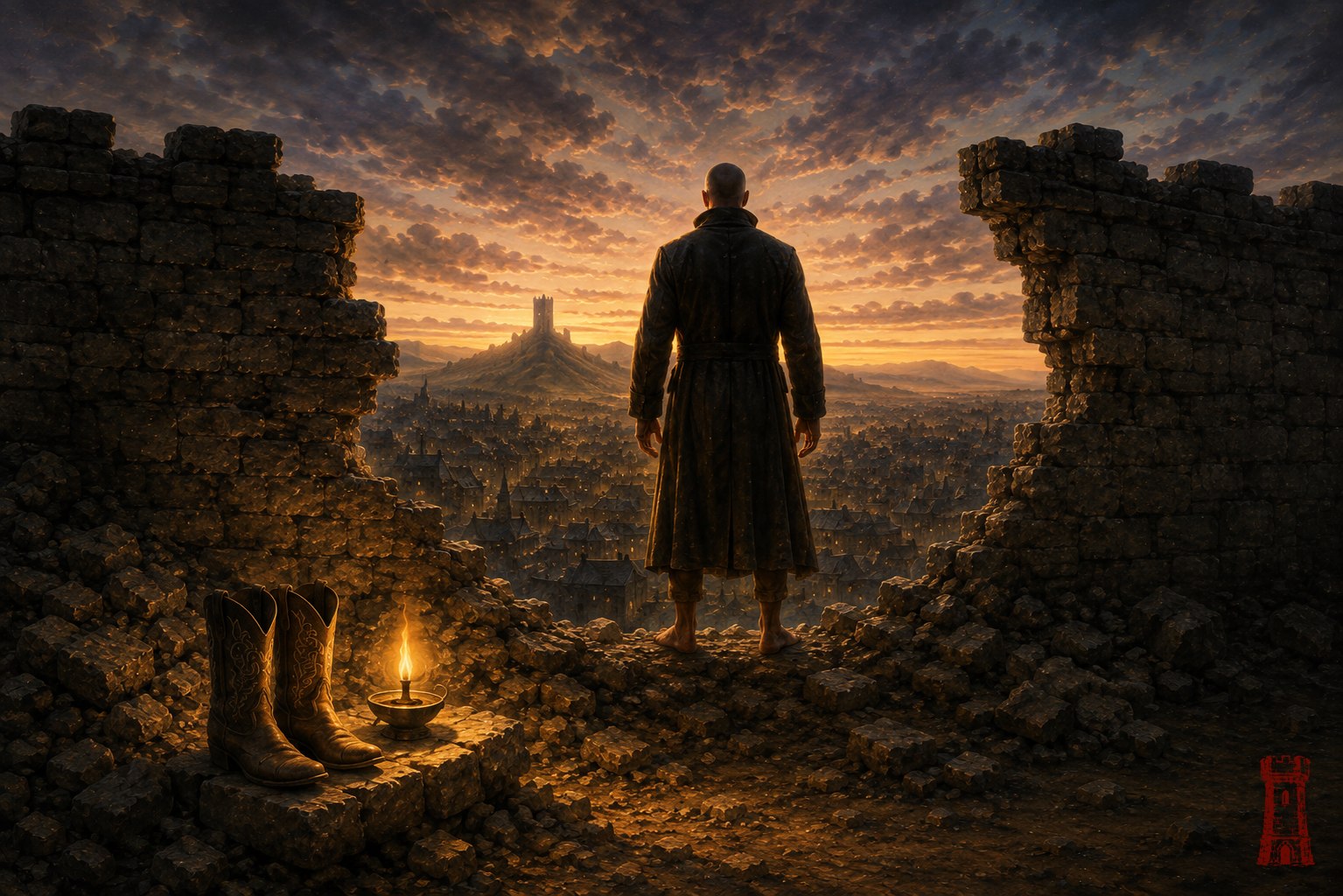
Wherever the broken jars are — the ones who speak rightly of the Father, who have had the high places torn out of their thinking and the strongman put out of their house, swept clean and filled with the Spirit of the living God — wherever those vessels go, carrying the Presence, that ground is holy. Not holy because of its particular purpose or consecration or the weight of what happens there. The ground is holy because He is in the midst of it, and He is in the midst of it when He is in you.
Moses recognized the distinction, the only thing that separates us from the people of the World — and it is not our good moral behavior, our refusal to use profanity in public, our excellent stewardship, our pragmatism, our lofty degrees and pedigrees, our courtroom victories or our high status in the community. There is only one thing that separates us from all other mankind — yea, all other creation — and it was lost way back in Eden. God offered Israel the Promised Land with an angel’s escort — milk and honey, victories included, everything but Himself — and Moses would not accept: If Your presence does not go, do not lead us up from here. For how then can it be known that Your people and I have found favor in Your sight? Is it not by Your going with us, so that we are distinguished, Your people and I, from all the other people on the face of the earth? (Exodus 33:15–16). This is the only distinguishing mark. Not our ethics; the world can match them. Not our excellence; the world can exceed it. The going-with. His Presence is the difference, the whole difference, the only difference between our practice and any other on the face of the earth.
And the Presence cannot be manufactured. It cannot be simulated or counterfeited; it cannot be purchased or conjured — the first two priests who tried offered strange fire and were consumed (Leviticus 10:1–2). It can only be received, daily, at the table that was first seen in heaven and set in the tabernacle: bread in the light of the watching Tree of Life, the Word in the basin, smoke going up morning and evening. Eat from the right tree, and then go — into the deposition and the mediation, the shareholder fight and the family’s worst week, into all the chaos and brokenness of a practice. The priest does not visit sacred places that are separated from the ordinary. He carries in the Presence of God so that wherever he stands is holy ground.
CONCLUSION AND PRAYER FOR RELIEF
I wrote, a few pages ago, that intercession is the motion before heaven that never stops being made, the prayer for relief that never stops being pleaded. It would be a failure by omission to end this series without making that pleading now. Every lawyer knows how a pleading ends — after the facts, after the standard, after the law and the argument, the document turns and finally says what it is seeking. The convention that every lawyer and judge recognizes is the use of one word that signifies we have come to the end, the conclusion. I have used the word numerous times, yet it never felt as weighty as it does now. Up to this point in the series, particularly in The Record, I appeared as the party, testifying against my own interests and speaking on my own behalf. Here, at the end of the argument and this series, I rise for and on behalf of you.
WHEREFORE, appearing before the highest Court of Heaven, admitted to its bar not by merit but by the Blood of the Lamb; moving by and through the Advocate of record, Jesus Christ the righteous, who ever liveth to make intercession — I pray this Court, for and on behalf of the one reading these words now: (1) That every high place still exalted in their thinking against the knowledge of Christ be torn down — by Your hand, not their own; (2) That the strongman, the old man, be bound and put out of the house; (3) That the house not be left swept and empty, but filled with Your Spirit, to overflowing; (4) That every accusation the adversary presents against them, day and night, be stricken and the handwriting entered against them blotted out, nailed to the cross; (5) That no breaking of theirs be wasted, but every broken thing become a fragrance of the life of Jesus — a sweet aroma before You; (6) That the ancient vacancy be filled — that they be appointed to the office posted at the foundation of the world (before the fall), commissioned, and sent; (7) That the office be provisioned daily — fire on the altar that does not go out, water in the laver that refreshes and cleanses, bread in the light of the Tree of Life that nourishes daily, prayers, intercessions, and supplications as incense ascending morning and evening — and that they work standing, because their seat is already settled in Christ; and (8) That this Court grant such other and further relief as it deems just and proper — for He is able to do exceedingly abundantly above all that we ask or think.
Respectfully — and boldly, as we are bidden to come to the throne of grace — submitted,
Michael C. Kelley, Esq.
Finally, O Reader — brother, sister, counselor — the last function of the office is the one I now perform, because this essay would be a lie if it described the blessing and then withheld it:
The LORD bless thee, and keep thee: The LORD make his face shine upon thee, and be gracious unto thee: The LORD lift up his countenance upon thee, and give thee peace. (Numbers 6:24–26)
And they shall put my name upon the children of Israel; and I will bless them.
The Name is on you. The gap is before you. Stand in it.
Turris fortis mihi Deus.
— — —
This Part closes the essay, the essay closes the series, and the series opens the way for further discussion (and perhaps more). Two years before the Lord brought me out of a long wilderness, He asked me what should come after — and then answered His own question: Turn your experience in the wilderness into a road that leads others to me. This series has been the first mile of that road. There is more — the Tabernacle, and how its furniture mirrors the Lamb; the camp, and what the high places saw when they looked down on it — why the curses couldn’t be pronounced; the Jubilee, and its peculiar survival in our own law; the faithful priest for whom God builds a sure house. I will even make a way in the wilderness, and rivers in the desert (Isaiah 43:19). I am excited and filled with anticipation over what God will do next. Not my will, but Thine be done.
• • •
Michael C. Kelley is a Florida attorney and shareholder at Lawson Huck Gonzalez, PLLC. He writes at Turris Fortis on faith, justice, and the practice of law as peacemaking — not the kind that confuses peace with avoidance, but the kind that contends for it with the weapons God supplies. Turris fortis mihi Deus — Prov. 18:10.
This is the seventh and final essay in a continuing series, best read in order — Start Here has the full map. It begins with Where Chaos Meets Holy Ground and continues through The Weapons of Peace, They Have Not Spoken Rightly of Me, Breaking the Jar, Tearing Down the High Places, and Bind the Strongman. It arrives in three parts: Part 1 — Preparation, Call, and Office; Part 2 — The Record; and this Part 3 — The Office Recovered. The series is complete.